Engineering & Buyer Guide
Autonomous Underground Rail Haulage: Architecture and Readiness Checklist
What must a mine prepare before implementing autonomous underground locomotive haulage?
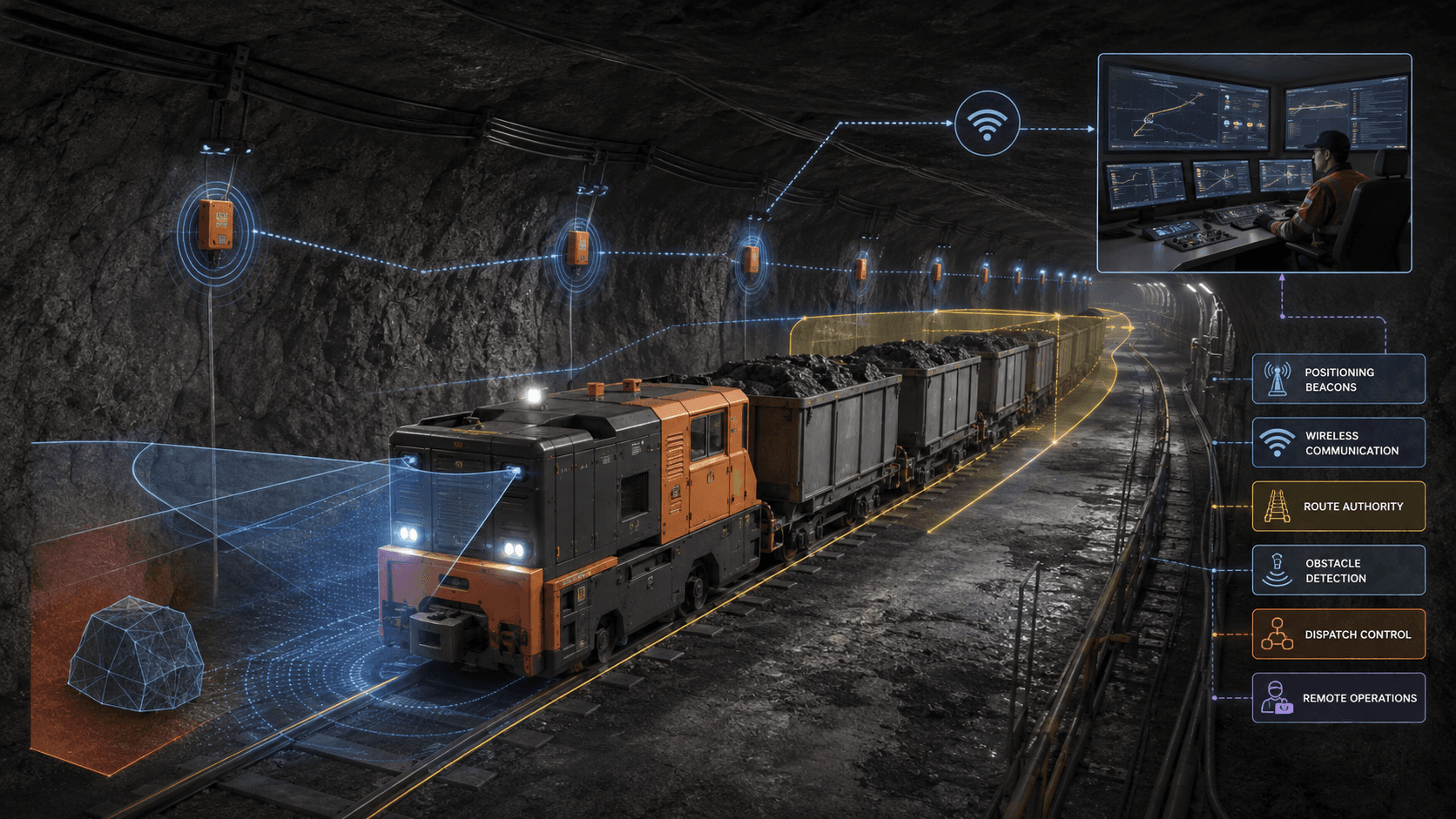
Conceptual system illustration: autonomous rail haulage connects the train, route, communications, positioning, protection and control room.
TL;DR / Direct Answer
What must a mine prepare before implementing autonomous underground locomotive haulage?
An autonomous underground rail-haulage project is ready for implementation only when the mine can define controlled operating zones, route authority, train detection and positioning, communications coverage, interfaces, safe states, degraded modes, recovery procedures, cybersecurity responsibilities and measurable acceptance tests. Buying an onboard controller alone does not create an autonomous system. Start with the operating concept and hazards, then verify infrastructure and interfaces before selecting automation hardware.
What is an autonomous underground rail-haulage system?
It is an operational system that assigns and supervises train movements inside a defined mine environment. It may coordinate onboard traction and braking control, train integrity inputs, route and switch status, localization, obstacle or intrusion detection, loading and unloading interfaces, wireless communications, central dispatch, alarms, logs and human intervention. The exact boundary must be written down because safety and performance gaps often appear between supplier packages.
Automation level should be described through permitted tasks and operating conditions, not a marketing label such as driverless. State who or what authorizes a movement, how the route is proved, what the train does when communication or localization quality degrades, and when an operator must intervene. The system also needs a controlled method for people, maintenance vehicles and manual trains to enter the automated area.
| Layer | Purpose | Readiness evidence |
|---|---|---|
| Operating concept | Defines routes, tasks, modes, people and production rules | Approved scenarios, boundaries and responsibilities |
| Vehicle control | Executes traction, speed and braking commands | Interface definition, limits, safe-state behavior and tests |
| Route authority | Prevents conflicting movements | Track blocks, switch proving, permissions and release logic |
| Positioning and detection | Determines train and obstacle status | Coverage map, accuracy/availability criteria and diagnostics |
| Communications | Carries commands, status, video or alarms | Coverage survey, latency/availability targets, QoS and redundancy |
| Supervision | Dispatches, displays, records and supports intervention | HMI philosophy, alarm rules, logs and operator training |
| External interfaces | Coordinates loading, dumping, power and production systems | Signal list, ownership, timing and failure behavior |
Why is system readiness a current procurement issue?
In September 2026, CNMC reported final acceptance and routine operation of an autonomous electric locomotive haulage project at Zambia's Chambishi Copper Mine. The announcement describes dual-train operation, automated loading and unloading, mobile communications, dispatch/protection and power-management integration. Those are project-specific claims from the project owner; they are useful here because they show that successful deployment is an integration and operating-model problem rather than a single-vehicle feature.
At the standards level, ISO/TC 82/SC 8 covers automated and autonomous mining systems and lists current work on reference architecture and communication interfaces. ISO 23725:2024 defines fleet-management/autonomous-haulage interfaces for surface haul trucks, not underground rail. Its scope limitation matters: it can inform interface thinking, but it must not be presented as an underground locomotive compliance standard.
Engineering note: Source discipline: current industry examples identify questions to ask; they do not prove that another mine, route or ShaoLi configuration will achieve the same outcome.
Which readiness gates should be closed before procurement?
A gate is closed only when evidence exists and the responsible mine authority accepts it. A supplier presentation, simulation or successful factory demonstration does not by itself prove underground route coverage, switch behavior, stopping performance, human exclusion or production integration at the site.
- Approve the operating concept, automation boundary and production scenarios.
- Complete route, rolling-stock, braking, power and hazard baselines.
- Define position, train-integrity, switch and intrusion information required for every movement.
- Survey communications and specify service levels for control, safety, monitoring and maintenance traffic.
- Assign every interface and safe state to an accountable system owner.
- Design manual, maintenance, degraded and emergency modes before normal automation logic.
- Create FAT, site integration, commissioning and operational-acceptance evidence with pass/fail values.
How should communications and positioning be specified?
Start from message criticality. Movement authority, emergency commands, machine status, alarms, voice, video and maintenance data do not necessarily need the same latency, availability or bandwidth. Define which functions must continue through a single failure, which may degrade, and which require a controlled stop. Epiroc's published underground automation material recommends dedicated network segmentation, quality-of-service for time-sensitive traffic and sufficient coverage; the mine still needs a site-specific design and validation plan.
Positioning should be specified by what the control logic must safely decide. Include route coverage, block and switch transitions, stopping points, direction, confidence or quality indication, update behavior and loss-of-position response. Do not state one accuracy number without tying it to vehicle dimensions, stopping tolerance, route geometry and the protection concept.
What must happen when the system is no longer fully healthy?
List credible faults: lost communications, uncertain position, unproved switch, occupied block, obstacle alarm, overspeed, failed train-integrity input, braking fault, power loss, stalled train, inconsistent database state and unavailable supervision. For each, define detection, immediate response, permitted movement, alarm, operator role, recovery authority and evidence recorded.
A safe state is context-dependent. Stopping immediately may be appropriate in one block but may create another hazard at a crossing, loading point or grade. The risk assessment should determine the controlled response. The NSW autonomous mobile plant guideline emphasizes lifecycle risk management, interaction with people and other plant, operating modes, control-system integrity and change management—principles that remain relevant even though a rail project needs its own detailed engineering.
How do people remain part of an autonomous system?
Automation changes work rather than removing accountability. Dispatchers need a clear operational picture, alarm priorities and authority boundaries. Maintainers need isolation, test and controlled-entry procedures. Production teams need rules for loading, dumping and abnormal material flow. Emergency teams need access and recovery plans that remain usable when communications or power are impaired.
The HMI should explain mode, authority, route, vehicle status, alarms and required action without forcing operators to infer system state from raw data. Training must cover normal, degraded, maintenance and emergency modes, followed by competency assessment and periodic drills. Access control should prevent a train from receiving authority into an area released for people or other equipment.
What is a practical implementation sequence?
Do not compress these stages into a single commissioning event. Each open assumption should have an owner and closure date. Software version, route database, vehicle configuration and safety-related parameters should be controlled so that an accepted result can be traced to the configuration that enters production.
| Stage | Main work | Exit evidence |
|---|---|---|
| 1. Baseline | Survey route, train, power, communications, operations and hazards | Approved requirements and gap register |
| 2. Design | Allocate functions, interfaces, safe states and acceptance criteria | Reviewed architecture and interface-control documents |
| 3. Factory verification | Test logic, simulated interfaces, alarms and fault responses | Traceable FAT results and open-item list |
| 4. Site integration | Install and validate route, network, positioning, switches and external systems | Coverage, interface and static test records |
| 5. Controlled trials | Run restricted scenarios with defined supervision | Scenario results, defects and approved corrections |
| 6. Operational acceptance | Demonstrate normal, degraded, emergency and recovery performance | Signed acceptance against measurable criteria |
| 7. Lifecycle control | Monitor changes, incidents, software, configuration and competence | Governed change and periodic validation process |
Which acceptance evidence should procurement require?
Tie payments and handover milestones to agreed evidence rather than broad statements such as system operational. Define who witnesses each test, acceptable results, retest rules and treatment of deferred functions. This gives both buyer and supplier a stable completion boundary.
- Requirements-to-test traceability for normal, degraded, maintenance and emergency scenarios.
- Route and communications coverage results with test conditions and unresolved exclusions.
- Positioning, block, switch and train-detection behavior at boundaries and failure conditions.
- Braking, stopping, holding and overspeed evidence for the approved train and grade cases.
- Interface tests for loading, unloading, power, signalling, dispatch and external systems.
- Alarm, event, command and configuration records suitable for incident reconstruction.
- Cybersecurity responsibilities, remote-access controls, backups and recovery arrangements.
- Manuals, training, spares, support escalation and configuration/change-control records.
Is retrofit or a new-build system the better starting point?
A retrofit may preserve rolling stock and reduce physical change, but legacy braking, control, wiring, documentation and interface access can limit automation. A new locomotive may provide cleaner integration, yet route infrastructure, mine processes and other rolling stock still require work. Compare both options through the same functional and acceptance requirements.
Begin with a bounded pilot only when the pilot architecture can grow without bypassing safety and configuration controls. A pilot that uses temporary coverage, manual workarounds or undocumented interfaces may demonstrate motion but not production readiness. Define what evidence is transferable to later routes and what must be repeated.
What should an automation RFQ include?
ShaoLi's autonomous transportation material and published case can support an initial technical discussion. The project team should still treat every proposed function, interface and performance value as configuration-specific until it is captured in approved project documentation.
- Current route and operating process, train formations, production targets and expansion plan.
- Vehicle, braking, switch, signalling, loading, unloading and power-system information.
- Automation boundary, required modes, human access and mixed-traffic assumptions.
- Communications architecture, coverage data, cybersecurity policy and remote-access rules.
- Applicable mine rules, local approvals, risk process and document language.
- Interface list, ownership matrix, acceptance scenarios, support model and change-control expectations.
Frequently asked questions
Does an autonomous locomotive require a driver underground?
That depends on the approved automation scope and operating mode. Define normal, remote, supervised, manual, maintenance and emergency modes explicitly instead of relying on the word driverless.
Can 5G alone make an underground haulage system autonomous?
No. Communications are one layer. Route authority, positioning, train and switch status, onboard control, braking, interfaces, procedures and acceptance evidence are also required.
How accurate must underground positioning be?
Accuracy must be derived from the decisions the system makes, vehicle and stopping tolerances, route geometry and protection design. One universal number is not defensible.
Can autonomous trucks standards be applied directly to underground rail?
Do not assume direct applicability. Some interface and lifecycle principles are informative, but scope, hazards, route control and jurisdiction differ.
What happens if wireless communication is lost?
The approved design must define detection, the controlled vehicle response, permitted degraded operation, alarms and recovery. The response is project-specific and should be tested.
Should a mine automate an existing locomotive or buy a new one?
Compare the legacy vehicle's control, braking, documentation and interface limitations against a new-build configuration using the same requirements and lifecycle cost model.
What proves that an autonomous haulage system is ready for production?
Traceable acceptance evidence for normal, degraded, emergency and recovery scenarios on the approved route and configuration, plus trained people and controlled lifecycle processes.
Sources & references
- CNMC Chambishi autonomous electric locomotive project announcement
Current project-owner report used as an attributed industry signal, not a transferable performance promise.
- ISO/TC 82/SC 8 automated and autonomous mining systems
Current scope and work programme for mining automation standards.
- ISO 23725:2024
Surface-mining interoperability scope used with an explicit scope limitation.
- NSW autonomous mobile mining plant guideline
Risk, people/plant interaction, control integrity and lifecycle guidance.
- Epiroc Deep Automation technical specifications
Published underground network segmentation, QoS and coverage considerations.
- NIOSH machinery and powered-haulage research
Context for proximity and interaction risk around mining machinery.
Turn the guide into a project requirement
Send the route, train, duty, power, environment and interface data. ShaoLi can review the requirement against relevant product and solution paths without treating a generic guide as a final design.
Request an engineering review