Engineering & Buyer Guide
Underground Mine Car Selection: A Rolling Stock Interface Checklist
How should an underground mine choose a mine car for a rail-haulage system?
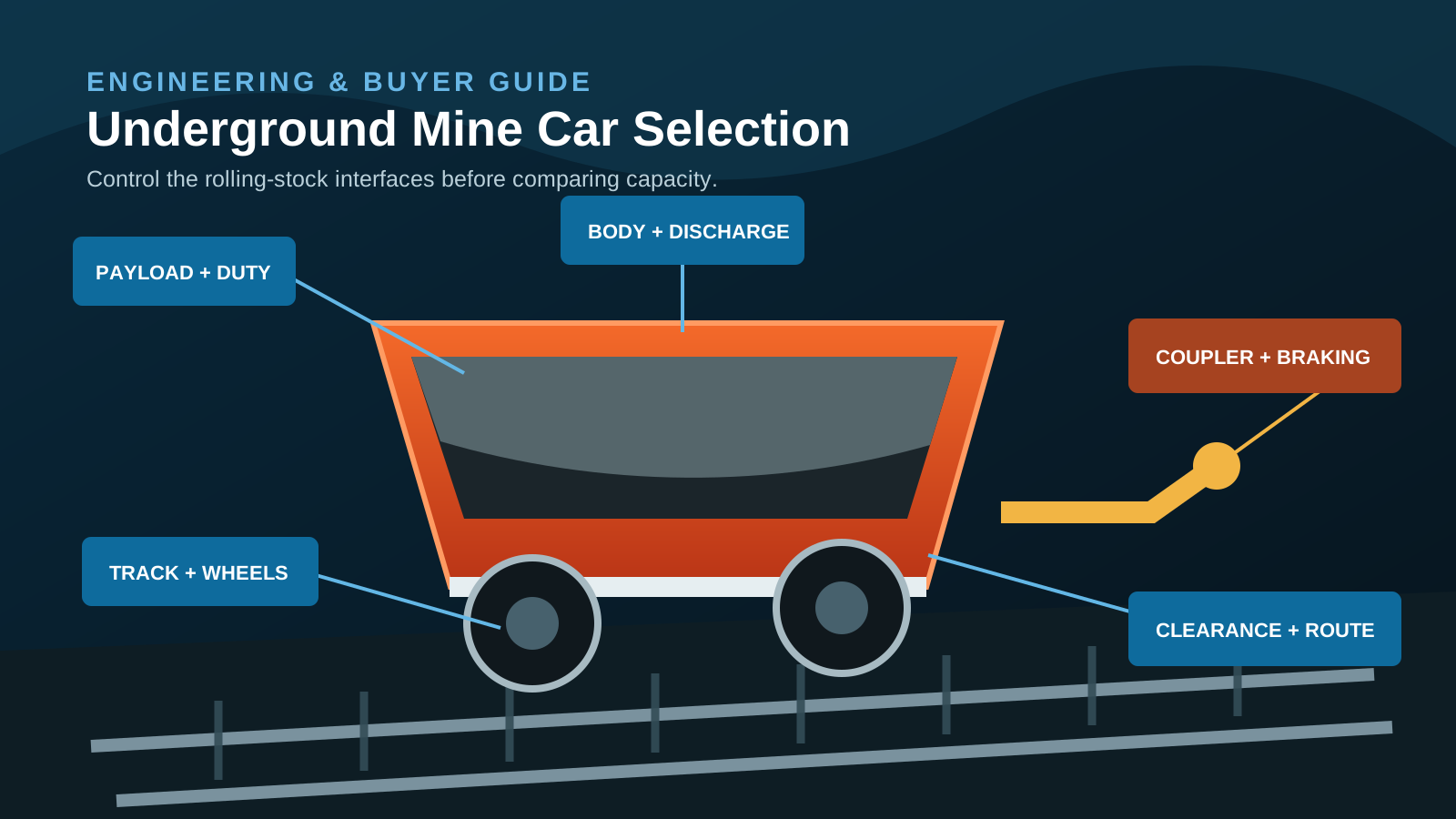
Conceptual illustration: mine-car capacity is only one input; rolling stock must fit the route, locomotive and operating controls as a system.
TL;DR / Direct Answer
How should an underground mine choose a mine car for a rail-haulage system?
Select a mine car from the complete haulage duty, not nominal volume alone. Define the material and its bulk density, payload target, loading and discharge method, gauge, rail and wheel interface, curve and clearance envelope, couplers, braking, approved train formation and locomotive capability. A car is suitable only when these interfaces are documented and the complete consist can be operated, stopped, inspected and recovered under the site's rules.
What are the non-negotiable mine-car selection gates?
Start by separating the transport task from the equipment name. Ore, waste, support materials and personnel create different containment, loading, unloading, restraint and safety requirements. Record normal and credible maximum loads, because a volume figure does not establish mass without the material's actual bulk density, moisture and fill behavior.
Then test six interfaces: duty and payload; loading and discharge; track and running gear; vehicle envelope; couplers and secondary retention; and braking with the intended locomotive. Each gate needs a project document or acceptance test. Unknown values should remain open actions rather than becoming catalogue assumptions.
| Decision gate | Questions to close | Useful evidence |
|---|---|---|
| Duty | What is carried, how often and under which abnormal loads? | Material data, cycle map, load cases |
| Loading/discharge | Does the body match the chute, tippler, side-dump or bottom-dump process? | Interface drawings and sequence |
| Route | Will wheels, gauge, curves, gradients and clearances remain compatible? | Track survey and envelope drawing |
| Train interface | Are coupler height, draw gear, safety connection and brake arrangement defined? | Consist schedule and interface drawing |
| Acceptance | How will mass, dimensions, running, dumping and braking be verified? | FAT/SAT plan and records |
Why are payload and body volume different decisions?
Nominal body volume becomes a load only after the project defines bulk density and a defensible fill factor. Wet or compacted material can change the mass carried in the same body. Oversize lumps, sticky material and uneven loading can also affect center of gravity, spillage and discharge. Do not use a generic density from an unrelated mine to finalize axle load or train mass.
Set both a payload limit and a loading control. The payload limit protects the car, track and train calculation; the loading control explains how operators or automated equipment avoid overfilling and off-center loading. Include tare mass, maximum gross mass and the method used to confirm them in the technical schedule.
Engineering note: A useful RFQ states material, measured or design bulk-density range, target payload, allowable gross mass and loading method. The supplier should identify every assumption used to propose a body volume.
How should the body and discharge method be matched to the process?
Fixed-body cars, side-dump cars, bottom-discharge cars and other arrangements impose different requirements on chutes, tipplers, unloading stations, clearances and operating sequences. A discharge method that works at one terminal may not fit another site's civil works or material flow. Identify where people may be exposed during coupling, release, tipping and clean-out.
For supplies or long materials, specify restraint points and loading rules. MSHA powered-haulage material stresses secure loads and suitable placement of long material; the principle is relevant as a hazard-control prompt, while the actual rule set depends on jurisdiction and mine type.
- Loading-chute opening, height, alignment and maximum instantaneous load.
- Discharge direction, receiving opening, actuation and reset confirmation.
- Sticky-material, carryback, oversize and manual-cleaning controls.
- Personnel exclusion zones and lockout or isolation responsibilities.
Which track and running-gear interfaces must be measured?
State track gauge, rail section, wheel profile, wheel diameter, axle arrangement, axle load and bearing arrangement. Survey the minimum curve radius, switches, crossings, gradient changes and track condition. The UK HSE track guidance explains that poor selection, installation or maintenance can contribute to derailment; its details are jurisdiction-specific, but the need to manage the track–vehicle interface is universal.
Check the dynamic envelope, not just the static width and height. Body overhang on curves, suspension movement, track tolerances, load shift and adjacent infrastructure can reduce clearance. The project should nominate who owns the track survey and which drawing is used for acceptance.
How do couplers, train formation and braking change the choice?
Document coupler type, coupling height, draw-gear capacity, articulation, buffers where used and any required secondary retention. Compatibility must be checked through dimensions and ratings, not photographs. A mismatch can create derailment, separation or uncontrolled-movement risk; MSHA investigation material provides a concrete warning about coupling and safety-chain failures in rail haulage.
Define the maximum approved consist: locomotive, number and type of cars, individual and total gross masses, loaded direction, operating speed and ruling gradient. Identify which vehicles are braked and how the complete train is held, stopped and recovered. Braking acceptance belongs to the system plan and cannot be inferred from a car catalogue.
- Issue a controlled coupling-interface drawing.
- Calculate train mass for every approved loading case.
- Define service, parking, emergency and runaway controls as applicable.
- Agree inspection, functional-test and stopping-test conditions.
- Record the approved consist and prohibit unreviewed substitutions.
What should the mine-car RFQ and acceptance plan contain?
Make acceptance measurable. Dimensions can be inspected, mass can be recorded, running and discharge can be demonstrated, and braking can be tested under an approved site procedure. The contract should say where each check occurs, who witnesses it, what constitutes a pass and how nonconformities are closed.
- Material and duty data, target payload, tare and maximum gross mass.
- Body type, volume basis, loading and discharge interface drawings.
- Gauge, rail, wheel, axle load, minimum curve and clearance envelope.
- Coupler, draw gear, safety connection and train-brake interfaces.
- Maximum consist, locomotive data, route profile and operating speed.
- Applicable standards, mine rules, inspections, FAT/SAT and document language.
- Wear parts, recommended spares, maintenance access and identification records.
Which maintenance and lifecycle questions belong in selection?
Selection should expose the parts and access conditions that will shape availability after delivery. Identify wheel and bearing inspection points, lubrication needs, draw-gear wear surfaces, pins, door or discharge mechanisms, liners and any brake components. Ask how wear is measured, which limits are project- or model-specific, and what tools or lifting arrangements are required. A low tare or large body does not create value if routine inspection cannot be performed safely in the available workshop.
Build the spare-parts plan from duty and consequence rather than copying an arbitrary kit. Separate commissioning spares, routine consumables, wear items and insurance spares. Record manufacturer part numbers, installed quantities, expected inspection basis, storage conditions and the information required to reorder a compatible component. Do not publish a universal replacement interval where operating severity, material abrasion and track condition control wear.
Lifecycle review should also cover cleaning, corrosion protection, drainage, repairability and end-of-service disposition. If the car body or discharge system is customized, agree how drawings and configuration records will be maintained. A later substitute wheelset, coupler or brake component should pass the same interface and change-control checks as the original selection.
- Confirm safe inspection and lifting access in the actual workshop.
- Define wear measurements and decision authority in the maintenance plan.
- Tie spare identities to the approved as-built configuration.
- Review modifications against gauge, axle load, clearance, coupling and braking interfaces.
Frequently asked questions
Can mine-car capacity be selected from body volume alone?
No. Body volume must be related to material density, fill behavior, tare mass, axle load, gross-mass limit and the approved train calculation.
Which mine-car type is best for ore haulage?
There is no universal type. Material behavior, loading equipment, discharge station, route clearances, maintenance and operating sequence determine the suitable arrangement.
Can an existing coupler be copied from a photograph?
No. Provide dimensions, coupling height, articulation, rating, draw-gear details and secondary-retention requirements on a controlled interface drawing.
Does every mine car need its own brake?
Requirements vary by system and jurisdiction. The complete consist, route, operating rules and failure cases must be assessed to define the approved braking arrangement.
What track data is needed for a quotation?
At minimum provide gauge, rail section, minimum curve radius, maximum gradient, switches or special trackwork, clearances and known condition constraints.
How should mine cars be accepted on site?
Use an agreed SAT covering identity, dimensions, interfaces, running behavior, loading/discharge functions and applicable braking tests under controlled conditions.
Sources & references
- HSE: Rail track and associated equipment for use underground in mines
UK guidance on track selection, installation and maintenance; apply only within its stated scope.
- HSE: Underground locomotive haulage
UK guidance on haulage control, trailing loads, braking, communication and training.
- South Africa: mandatory COP guideline for underground rail-bound transport
Jurisdiction-specific example of equipment registers, vehicle data and risk controls.
- MSHA Underground Powered Haulage 2021
US training material covering track, speed, couplers, safety chains and material security.
- MSHA fatal investigation: supply-car coupling
Incident evidence illustrating why coupling compatibility and secondary retention require control.
- Wabi mine cars
Competitor example of payload, dump style, wheel size and gauge as mine-car configuration factors.
Turn the guide into a project requirement
Send the route, train, duty, power, environment and interface data. ShaoLi can review the requirement against relevant product and solution paths without treating a generic guide as a final design.
Request an engineering review