
Engineering & Buyer Guide
Underground Mine Battery Charging Station: A Design and Procurement Checklist
What must a mine define before procuring an underground locomotive battery charging station?
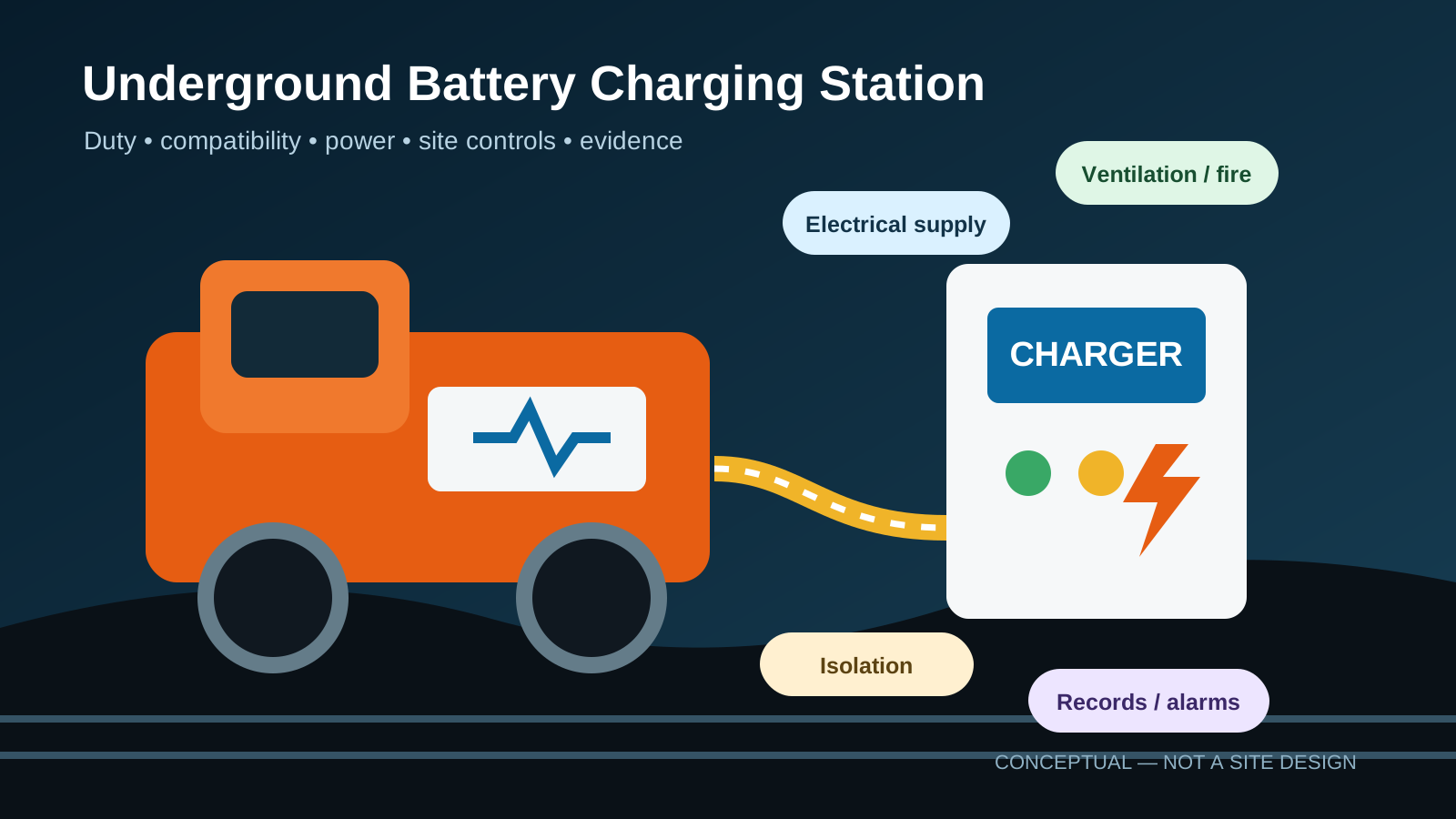
Conceptual system map: charger procurement begins with the operating duty and site controls, not connector selection alone.
TL;DR / Direct Answer
What must a mine define before procuring an underground locomotive battery charging station?
An underground mine battery charging station is part of the haulage system, not a loose accessory. Define the locomotive battery, usable shift energy, charging windows, charger interface, incoming electrical supply, location, ventilation and fire strategy, isolation, traffic control, emergency response, data records and local approval before equipment is ordered. Requirements vary by battery chemistry, mine type and jurisdiction, so this checklist is a procurement framework rather than a universal design specification.
What is the minimum defensible design basis?
Begin with a controlled schedule for every battery-powered locomotive expected to use the station. Record battery chemistry and configuration, nominal and permitted voltage range, rated and usable energy, maximum approved charge current, battery-management or monitoring interface, connector and communication requirements, normal state of charge on arrival, operating temperature limits and the responsible equipment supplier. A label such as lithium battery or lead-acid battery is not enough to establish charger compatibility.
Map the real shift: trips, loaded and empty movements, delays, energy consumed, planned charging opportunity and contingency duty. The station must support the fleet schedule when one locomotive arrives late, a charger is unavailable or a battery needs inspection. The design basis should state which assumptions are measured, which are calculated and which still require confirmation. This prevents catalogue charge time from becoming an unsupported production promise.
| Input | Define before RFQ | Evidence to request |
|---|---|---|
| Battery | Chemistry, voltage window, usable energy, current and temperature limits | Controlled battery and BMS specification |
| Duty | Arrival state of charge, available window, trips and reserve | Measured cycle data and energy model |
| Fleet | Number of locomotives, simultaneous demand and redundancy | Shift schedule and charger availability case |
| Site | Location, access, electrical supply, ventilation and environment | Survey, single-line diagram and layout |
| Control | Connection, isolation, permissions, alarms and records | Interface schedule and operating procedure |
How should battery and charger compatibility be proved?
Compatibility is an engineered interface. Match the complete charge profile, voltage and current limits, polarity, connector rating and keying, cable duty, protective earth where applicable, communication protocol, permissives, temperature inputs, fault behavior and battery-management commands. The charger should not rely on an operator to compensate for an incorrect profile. Record approved firmware and configuration versions so replacement equipment cannot silently change the charge behavior.
Ask the battery and charger parties to sign one interface schedule. It should identify who owns the battery limits, who validates the charger settings, how loss of communications is handled and which alarms stop or inhibit charging. Where batteries are exchanged, also define lifting, restraint, guides, connector protection and identification. A successful plug-in demonstration does not prove correct charging across temperature, state of charge, faults and repeated service.
How many chargers and how much power are required?
Calculate energy that must be returned during each charging window, then apply the approved charge limits and realistic efficiency assumptions. Distinguish charger input rating, charger output rating and energy actually restored to the battery. Sequence simultaneous demand against the mine distribution system rather than multiplying nameplate ratings without context. Include auxiliaries, ventilation and any environmental controls in the site load assessment.
Capacity needs an availability case as well as a normal case. Model the busiest shift, charger maintenance, delayed arrival, a battery held for inspection and any planned fleet expansion. Decide whether the station needs spare capacity, load management or staggered charging. State the consequence when capacity is unavailable: reduced trips, battery exchange, controlled waiting or another approved arrangement. This turns redundancy from a sales adjective into an operating decision.
- Measure representative locomotive energy use over complete loaded and empty cycles.
- Define the permitted battery state-of-charge window and contingency reserve.
- Place every locomotive and charger on a shift timeline.
- Calculate coincident electrical demand and check the distribution study.
- Repeat the model with one charger unavailable and with the planned fleet expansion.
- Approve the operating response for every capacity shortfall.
What belongs in the location, ventilation and fire review?
The project team should select the charging location through the mine risk process and applicable rules. Consider ventilation path and capacity, heat and any gas generation relevant to the battery system, combustible loading, water and contamination, impact exposure, roof and ground conditions, drainage, access for inspection, separation from traffic, escape routes and emergency-service access. Requirements can differ sharply between underground coal, metal and non-metal mines and between jurisdictions.
Primary sources show why jurisdiction must be explicit. United States underground coal provisions address fireproof charging areas and routing ventilation to return air; an ILO underground coal code discusses properly arranged charging stations and fire suppression; NSW has published a safety bulletin on underground battery-electric vehicle fire risk. These sources are useful prompts, but none should be copied as the final requirement for an unrelated site. The mine must identify the controlling authority and approved fire and ventilation strategy.
Engineering note: Scope boundary: this guide does not prescribe separation distances, ventilation quantities, fire-agent selection or hazardous-area classification. Those decisions require the actual battery system, mine conditions and applicable authority.
Which electrical and isolation interfaces must be documented?
Issue a single-line diagram from the mine supply to each charger and connection point. Define voltage, frequency, earthing arrangement, protective devices, fault level, cable routing, disconnection and lockout, emergency stop behavior, surge or harmonic review where required, inspection access and responsibility boundaries. Verify that upstream protection and charger behavior coordinate under credible faults rather than treating the charger breaker as the complete safety case.
The connection sequence should prevent exposed energized contacts and unintended movement. State parking and restraint requirements, connector inspection, permission to connect or disconnect, charge-enable conditions, communications loss response, emergency isolation and return-to-service checks. Design the controls for the operator's real gloves, lighting, access and line of sight. Label every isolator and connection consistently with drawings, procedures and maintenance records.
How should charging be operated and maintained?
Create a role-based procedure covering arrival checks, parking, isolation, connection, start permission, monitoring, abnormal alarms, disconnection and release to service. Define who can change a charging profile and require configuration change control. Operators need concise instructions; maintainers need electrical drawings, diagnostic limits and safe test methods; supervisors need availability and exception records. Training should include abnormal conditions and recovery, not only a normal charge cycle.
The maintenance plan should cover connectors, cables, strain relief, guards, cooling paths, filters, fasteners, contactors, protective functions, sensors, software configuration, ventilation interfaces and housekeeping. Set inspection intervals from supplier instructions, duty and site risk, then adjust them using evidence. Battery state-of-health, charger faults, aborted cycles and temperature exceptions can reveal deterioration before production is affected, provided the records are reviewed rather than merely stored.
- Daily or shift checks with clear stop-work criteria.
- Planned inspection and functional tests tied to named components.
- Controlled charger settings, firmware and backup records.
- Critical spare parts, support contacts and replacement lead times.
- Battery and charger event data retained for trend and incident review.
What should factory and site acceptance prove?
Factory acceptance should verify identity, ratings, configuration, interface signals, protective functions, alarms, communications, data records and agreed simulated faults. Site acceptance should then verify the installed supply, isolation, ventilation and fire interfaces, signage, traffic controls, physical connection, normal charging, loss of supply or communications, emergency stop, restart conditions and handover records. Test methods and pass criteria belong in the contract before shipment.
Complete a monitored proving period with representative batteries and shifts. Review charge duration, returned energy, arrival and departure state of charge, peak demand, temperatures, alarms, interruptions and operator interventions. Close defects through a controlled register and repeat affected tests. Handover is complete only when the mine has approved drawings, settings, certificates, manuals, spares, training records and a practical escalation route.
What should the charging-station RFQ contain?
Package the design basis so bidders solve the same problem. Include locomotive and battery schedules, operating cycle, electrical supply, proposed location, mine environment, controlling rules, fleet growth, data and communications needs, installation boundaries and acceptance plan. Ask suppliers to list deviations and assumptions beside each requirement. A compliant answer should name the proposed equipment and configuration rather than offer an unqualified charger family.
Commercial comparison should include engineering, charger cabinets, cables and connectors, distribution and civil works, ventilation or fire interfaces, installation, commissioning, training, spares, software or licenses, remote support controls and lifecycle service. Keep project-specific performance conditional until duty data and interfaces are approved. ShaoLi can review locomotive-side battery and charging information as part of a project configuration discussion; mine design and local approval remain the buyer's controlled responsibilities.
- Battery schedule and signed battery–charger interface matrix.
- Normal, peak, degraded and expansion capacity cases.
- Site layout, supply single-line and responsibility matrix.
- Operating, maintenance, emergency and configuration-control requirements.
- FAT, SAT, proving-period and document-handover criteria.
Frequently asked questions
Can one charger be used for every mining locomotive battery?
Do not assume so. Battery chemistry, voltage range, permitted current, charge profile, connector, communications, monitoring and protective behavior must all match the approved battery configuration.
How many chargers does an underground locomotive fleet need?
Use the measured duty, arrival state of charge, available windows, permitted charge rate, simultaneous demand and an agreed charger-unavailable case. Fleet count alone cannot answer the question.
Must a battery charging station be underground?
That depends on the operating arrangement, battery handling, route, mine design and applicable rules. Compare locations through a documented risk, logistics and electrical review.
What ventilation is required for charging?
There is no responsible universal value. Requirements depend on battery chemistry, charge behavior, charger losses, mine environment and the authority having jurisdiction.
Is a client authorization code or software setting enough to protect charging?
No. Safe charging also needs compatible hardware, protective functions, isolation, permissions, procedures, inspection and controlled configuration records.
What records should the station retain?
At minimum retain equipment identity, approved settings, start and finish data, energy or state-of-charge information where available, temperatures, alarms, interrupted cycles, inspections, maintenance and configuration changes.
Can charger nameplate time be used in the production plan?
Only after it is reconciled with the approved battery limits, starting state of charge, temperature, taper behavior, supply capacity and real operating window.
Sources & references
- MSHA Federal Mine Safety and Health Act provisions
United States underground-coal context for charging-station fire and ventilation provisions; jurisdiction-specific.
- ILO Safety and health in underground coalmines
International code-of-practice prompts for charging-station arrangement and fire controls; not a substitute for local law.
- NSW Resources Regulator safety bulletin: underground BEV battery fire risk
Lifecycle battery-risk and change-management guidance in its stated NSW context.
- Canada Coal Mining Safety and Health Regulations
Federal Canadian coal-mining provisions used only as a jurisdiction example.
- HSE mining publications and guidance
Primary regulator index used to identify scope and current guidance boundaries.
Turn the guide into a project requirement
Send the route, train, duty, power, environment and interface data. ShaoLi can review the requirement against relevant product and solution paths without treating a generic guide as a final design.
Request an engineering review