
Engineering & Buyer Guide
Battery vs Trolley Mining Locomotive: An Underground Haulage Selection Matrix
Should an underground mine choose a battery locomotive or a trolley locomotive?
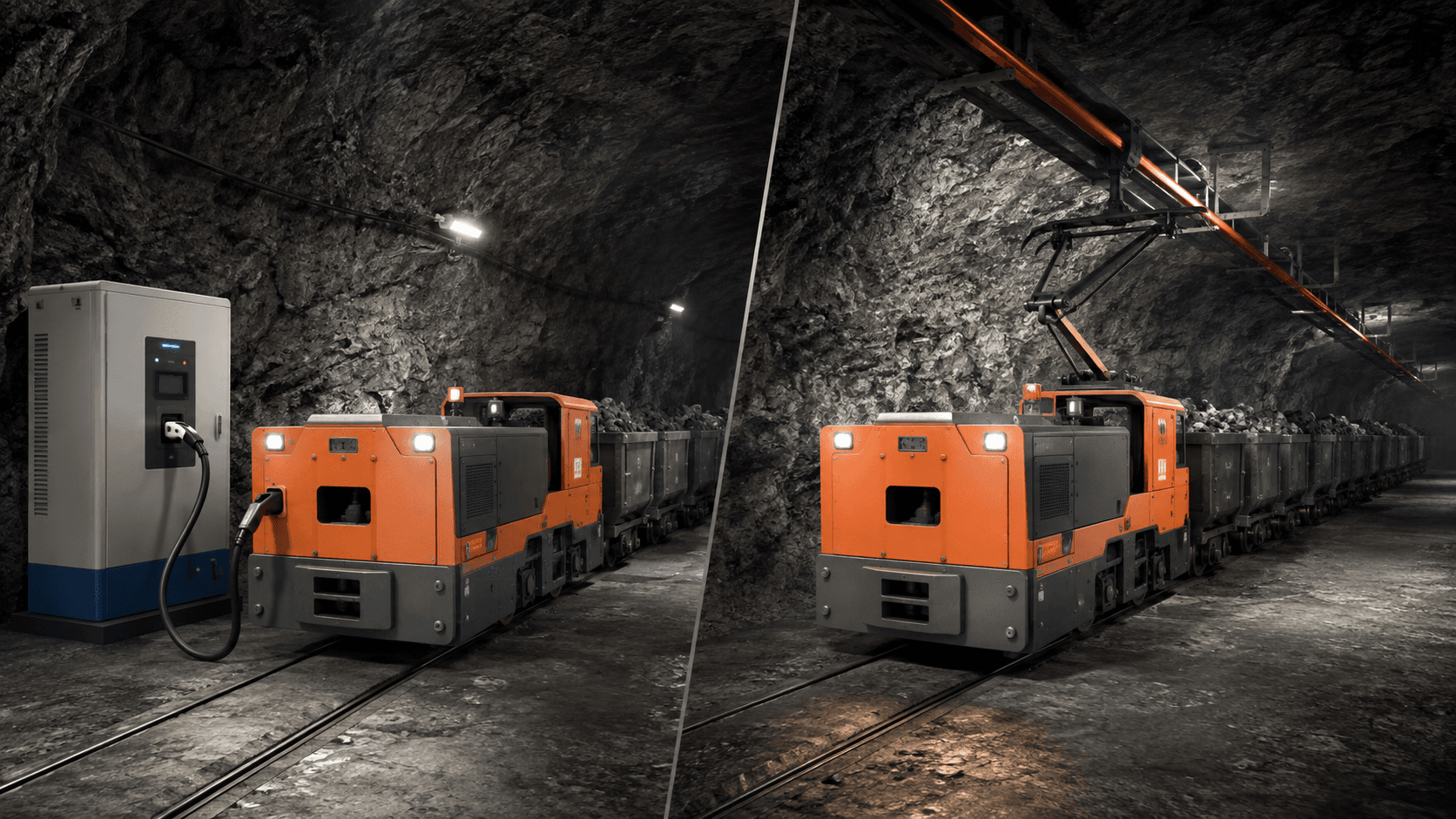
Conceptual illustration: the power-source decision changes infrastructure and operating requirements; it does not determine the final locomotive model by itself.
TL;DR / Direct Answer
Should an underground mine choose a battery locomotive or a trolley locomotive?
Choose a battery locomotive when route flexibility and operation away from a continuous overhead conductor outweigh charging, battery-handling and energy-storage constraints. Choose a trolley locomotive when a stable, repetitive route can support a maintained overhead supply and continuous power is more valuable than off-wire flexibility. Neither answer is universal: gauge, maximum gradient, train mass, curve radius, operating hours, hazardous-area rules, braking and local approvals must be checked together before a model is selected.
What is the fastest defensible decision rule?
Start with the route, not the locomotive catalogue. A fixed production loop with dependable electrical infrastructure can make trolley power operationally attractive because the locomotive draws energy while working. A changing development heading, disconnected work area or route where an overhead conductor is impractical usually strengthens the case for battery power. This first screen only identifies a direction; it does not prove capacity or compliance.
The selection must then survive five gates: the train can start and move on the ruling gradient; the braking arrangement can control the approved consist; the locomotive and rolling stock fit the gauge, curves and clearances; the chosen power infrastructure supports the shift plan; and the complete system is acceptable under the mine's rules and jurisdiction. A failure at any gate returns the project to engineering review.
| Decision factor | Battery locomotive | Trolley locomotive | Evidence to request |
|---|---|---|---|
| Route | Works without a continuous overhead conductor | Best suited to an electrified, repeat route | Route plan, gradients, clearances, work zones |
| Energy | Stored onboard; charging strategy is part of capacity | Drawn from overhead supply while operating | Shift energy model, supply study, peak demand |
| Flexibility | Can cover non-electrified sections within the approved duty | Movement normally follows conductor coverage | Operating scenarios and contingency routes |
| Infrastructure | Charging, handling, isolation and battery-area controls | Substation, conductor, sectioning, return circuit and isolation | Single-line diagram and site responsibility matrix |
| Maintenance focus | Battery, charger, connectors, thermal and state-of-health records | Collector, conductor, insulators, return path and supply protection | Maintenance plan, critical spares and competencies |
| Primary unknown | Usable energy across the real shift | Availability and condition of the power network | Measured duty data rather than assumptions |
What exactly is being compared?
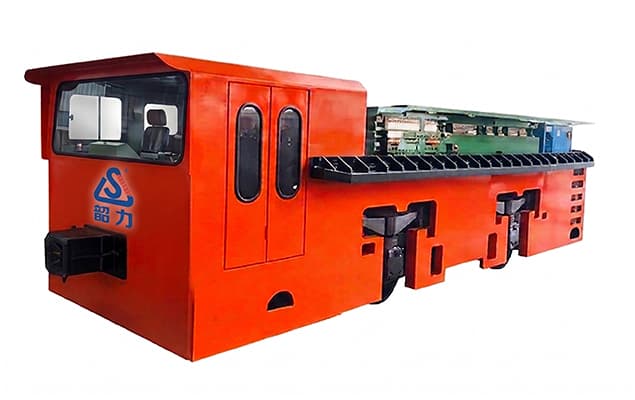
A mining battery locomotive carries its traction energy onboard. The engineering question is not simply battery chemistry or nameplate capacity; it is whether usable energy, allowable discharge, thermal limits, charging windows and degradation assumptions support the required work. Lead-acid and lithium-based systems also have different handling, monitoring and emergency-response needs, so the battery type must be named in the technical agreement.
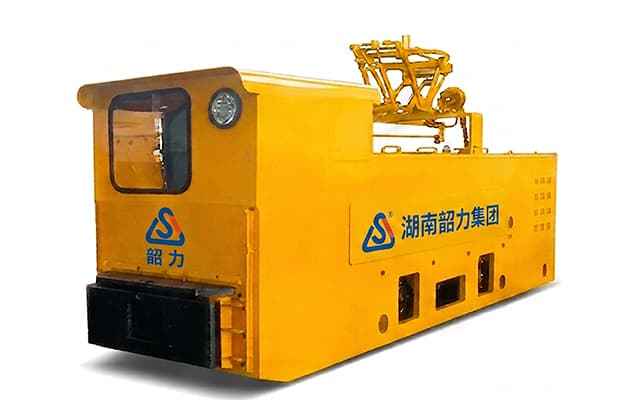
A trolley locomotive receives traction power from an overhead conductor through a current collector. The locomotive cannot be evaluated independently from the substation, feeder, conductor height and alignment, sectioning, earthing or return path, isolation procedure and maintenance access. Hybrid or auxiliary battery arrangements may bridge short gaps, but they should be specified as a defined operating mode rather than treated as unlimited off-wire capability.
How do route and duty cycle change the answer?
Map one complete operating cycle: loading, acceleration, loaded travel, stops, unloading, empty return, waiting and charging or maintenance. Record the maximum train mass in each direction and identify the ruling gradient, not merely the average grade. Curves, switches, wet or contaminated rail and speed restrictions can change resistance and adhesion at the same time.
For a battery system, calculate energy over the realistic cycle and then test the shift schedule against charging access and contingency margin. For trolley power, trace conductor coverage through every movement, including loading pockets, workshops, sidings and recovery locations. The best power system is the one that supports the operating plan under credible disruption—not the one with the most attractive isolated specification.
- Define loaded and empty consist masses, couplers and braking interfaces.
- Survey gauge, gradient profile, minimum curve radius, rail condition and clearances.
- Build the cycle time and required trips per shift.
- Model battery charging windows or trolley-network availability.
- Check abnormal modes: stalled train, power loss, blocked route and recovery.
- Confirm the proposed configuration through calculation, drawings and acceptance tests.
Why do traction and braking remain power-source-neutral gates?
Battery and trolley locomotives still obey the same basic rail-haulage constraints. Required tractive effort must overcome rolling, gradient and curve resistance and provide any required acceleration. Available wheel-rail adhesion limits how much force can be used without slip. Motor power affects force at speed, while starting and continuous tractive effort answer different questions. A catalogue tonnage must therefore never replace a route-specific resistance check.
Braking is a separate verification. The approved train mass, speed, grade, brake distribution, response, thermal duty and failure behavior must be defined. The NSW Resources Regulator describes underground transport braking as essential to preventing unwanted movement and collisions and treats design, testing and performance as a system concern. Local rules and the project risk assessment take precedence over this general comparison.
Engineering note: Decision checkpoint: do not choose battery or trolley power until both the worst-case traction calculation and the braking/holding case use the same approved train and route assumptions.
Which infrastructure belongs in the commercial comparison?
Battery procurement must include chargers, electrical supply, charging location, ventilation and fire controls, connection and isolation method, handling equipment where batteries are exchanged, monitoring data, spare battery strategy and end-of-life responsibility. A locomotive price without these items is not a project cost.
Trolley procurement must include substations and feeders, overhead conductor and supports, section isolation, signage, rail bonding or return arrangements where applicable, protection coordination, maintenance access and spares. Installation may interact with roof support, clearance envelopes and work near live conductors. The ILO code of practice discusses guarded or isolated trolley-wire areas and separately calls for properly arranged battery charging stations; the applicable national requirements must be confirmed for the actual mine.
What safety and hazardous-area questions must be answered?
Ask the mine to classify the operating environment and identify the authority that accepts the equipment. Do not infer hazardous-area suitability from the words battery, electric or underground. Equipment construction, electrical protection, monitoring, enclosure, battery ventilation, charging, trolley-wire location and isolation may all be regulated differently by jurisdiction and mine type.
Battery risk review should cover the full lifecycle: transport, storage, charging, operation, impact, thermal event, firefighting, recovery and disposal. The NSW safety bulletin specifically recommends lifecycle risk and change-management review for underground battery-electric vehicles. Trolley review should cover contact with live equipment, loss of supply, conductor damage, arcing, isolation and safe work around the network. Both systems need route rules, inspection and emergency arrangements.
How should lifecycle cost be compared without using a misleading online price?
Use a project cost model with the same study period and production duty. Include locomotive and rolling-stock configuration, civil and electrical infrastructure, installation, commissioning, energy, planned maintenance, inspections, consumables, critical spares, battery replacement or conductor renewal, downtime exposure, training and end-of-life work. State which party supplies each item.
Sensitivity matters more than a single total. Test what happens if trips increase, charging time shrinks, electricity availability changes, the route extends or a critical component is unavailable. This makes the comparison useful even when vendor quotations are not yet final. It also prevents a lower equipment price from hiding a larger infrastructure or operational constraint.
| Cost group | Battery questions | Trolley questions |
|---|---|---|
| Capital | Locomotive, battery, charger, handling and charging-area works | Locomotive, substation, feeder, conductor, supports and protection |
| Operations | Energy per cycle, charging labor, battery rotation | Network losses, inspections, isolations and route restrictions |
| Renewal | Battery life assumptions and replacement logistics | Collector wear, conductor and power-equipment renewal |
| Risk | Missed charge, thermal event, battery unavailability | Supply outage, conductor damage, restricted off-wire recovery |
What should the RFQ contain?
A supplier can then compare configurations against a controlled requirement set. Unknown values should be marked unknown rather than guessed. The first commercial response should identify assumptions and exclusions so engineering and procurement teams can close them before contract award.
- Route drawing and gradient profile, gauge, rail section, minimum curve radius and clearance envelope.
- Mine-car type, payload, number of cars, total masses, coupler and train-brake arrangement.
- Trips per shift, cycle-time target, operating hours, loading and discharge process.
- Available electrical supply, proposed charging windows or trolley-network details.
- Ambient and underground conditions, water/dust exposure and hazardous-area classification.
- Required approvals, language, inspection, FAT/SAT, manuals, training, spares and destination.
- Known future route extensions, production increases and interfaces with signalling or automation.
Frequently asked questions
Is a battery locomotive always more flexible underground?
It is independent of a continuous overhead conductor, but its usable route and shift flexibility still depend on battery energy, charging access, thermal limits, approved operating conditions and recovery arrangements.
Is a trolley locomotive always cheaper to operate?
Not necessarily. The answer depends on utilization, electricity and network costs, infrastructure maintenance, outages, route changes and the comparison period. Use a project lifecycle model.
Can one locomotive weight determine hauling capacity?
No. Train resistance, ruling gradient, curves, rail condition, adhesion, speed, motor characteristics and braking must be evaluated together.
Can lithium and lead-acid battery locomotives use the same charging plan?
Do not assume so. Chemistry, battery-management requirements, charger compatibility, ventilation, handling and emergency procedures must match the supplied system.
Can a trolley locomotive run where the wire ends?
Only if the specified configuration includes an approved auxiliary power mode and its operating limits cover that movement. A conventional trolley locomotive depends on conductor coverage.
Which option is better for a tunnel construction project?
Changing headings and temporary logistics may favor onboard energy, while a long repetitive route may justify fixed supply. Construction sequence, clearances, ventilation, charging and relocation plans decide the result.
What information is needed for a meaningful quotation?
Provide route, gauge, gradient, curves, train mass, cycle, power availability, environment, approvals, destination and required service scope.
Sources & references
- Schalke mining locomotive technical data
Examples of route- and configuration-specific power modules, gauge, tractive effort and transport data.
- Clayton mining product leaflet
Manufacturer documentation showing battery and overhead-line configurations and application-dependent specification.
- ILO Safety and health in underground coalmines
Transport rules, trolley-wire and storage-battery guidance.
- NSW Resources Regulator battery fire bulletin
Lifecycle risk and change-management considerations for underground batteries.
- NSW Resources Regulator underground braking guide
System-level braking design, testing and documentation context.
Turn the guide into a project requirement
Send the route, train, duty, power, environment and interface data. ShaoLi can review the requirement against relevant product and solution paths without treating a generic guide as a final design.
Request an engineering review