Engineering & Buyer Guide
Mine Locomotive Coupler Inspection: A Drawgear, Interface and Release Plan
What should a mine check before returning a locomotive and mine-car coupling to service?
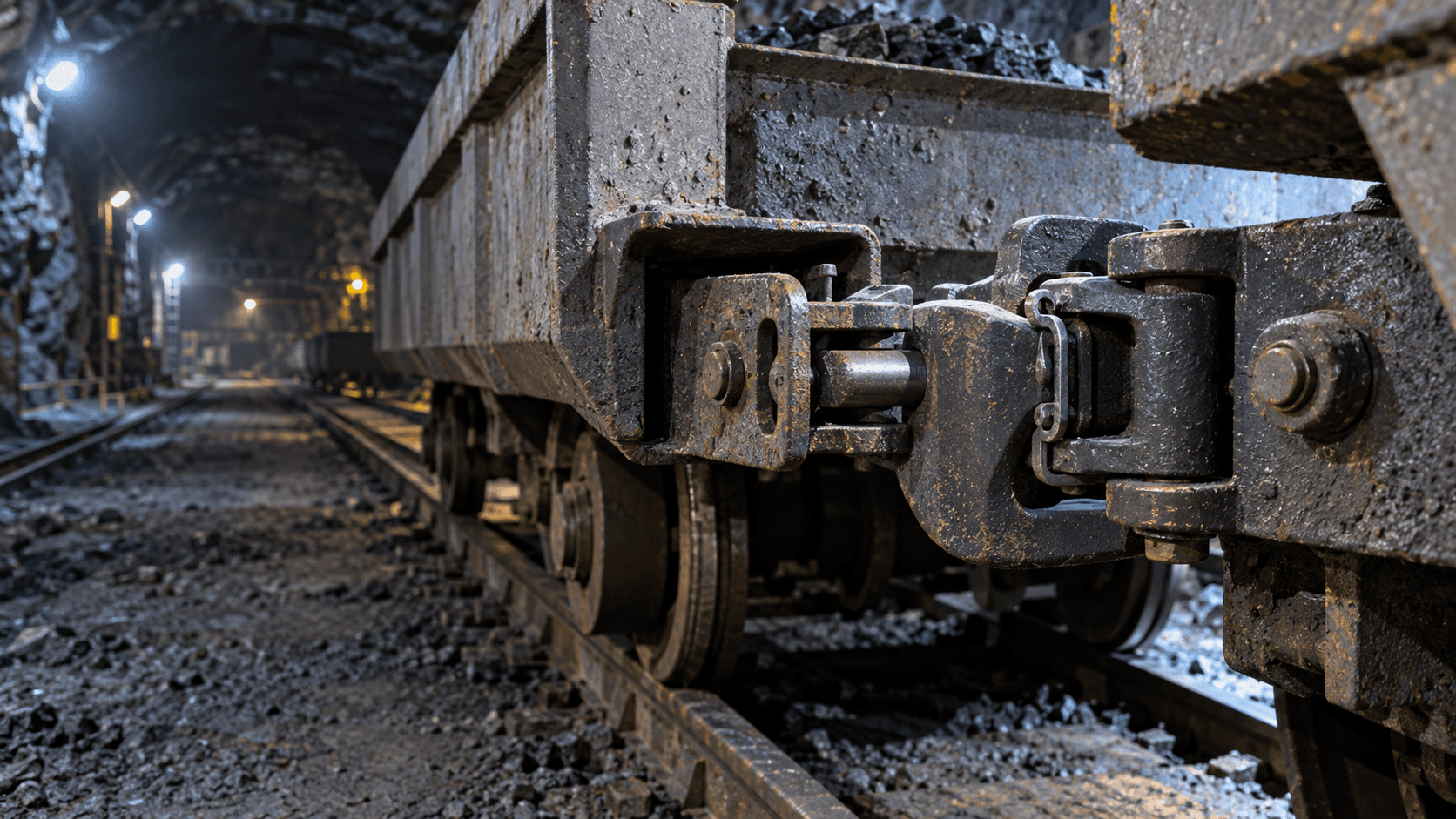
AI-generated illustrative scene. The coupling geometry is generic and is not a ShaoLi product, customer site or inspection record.
TL;DR / Direct Answer
What should a mine check before returning a locomotive and mine-car coupling to service?
A safe coupler inspection covers the complete connection between locomotive and cars: coupling head or pin arrangement, lock or retention, shank and draft gear, mounting, height and alignment, secondary restraint where specified, operating method and recorded condition. Secure the vehicles before inspection, compare findings with the actual manufacturer's limits and mine rules, remove uncertain or defective equipment from service, and release it only after documented repair and functional verification. No universal wear limit is supplied here.
Why inspect the train connection rather than only the coupler head?
The coupler head is only one part of the load path. A locomotive can have a sound-looking head but a damaged shank, worn lock, displaced pin, loose mount, cracked yoke, compromised draft gear, misaligned car or incompatible coupling height. The inspection boundary runs from the vehicle structure through the drawgear and coupling device to the mating car, then through any required secondary retention. Train mass, grade, curve and shunting practice affect the forces this boundary sees.
Start with the mine's exact fleet and operating arrangement. Irwin's manufacturer page shows that mining and tunneling fleets may use Willison, Sharon, industrial and other coupler families; its statements describe its own products, not ShaoLi's fitment. The approved arrangement could be automatic, pin-and-link or another specified system. Inspection points and acceptance limits must be drawn from the installed design, its manufacturer instructions and the mine's current rules, not copied from a different coupler type.
| Element | What to identify | Evidence before release |
|---|---|---|
| Coupling device | Type, head, pin/lock, latch and operating lever | Approved component drawing and measured condition |
| Drawgear | Shank, yoke, pocket, draft element and fasteners | Inspection and repair record |
| Vehicle interface | Mounting, height, alignment, end structure and curve behavior | Mated-vehicle compatibility review |
| Secondary restraint | Chain/cable/device if specified | Correct arrangement and condition |
| Operations | Coupling method, securing, shunting and release authority | Functional check and sign-off |
What must happen before anyone approaches the connection?
Apply the mine's approved movement protection and isolation procedure. Secure each vehicle against movement, coordinate with dispatch or the responsible traffic authority, protect the track section and prevent other equipment from entering. Do not stand between vehicles or rely on a locomotive brake as the only restraint while the consist can move. The exact chocking, blocking, isolation and communication method is site-specific and must be taken from the mine's rules.
Identify locomotive and car numbers, coupler type and part/revision, direction of connection, load and route history, last inspection, recent repairs and reported symptoms. Ask whether unintended uncoupling, difficult engagement, impact, unusual slack or vertical displacement has occurred. Record photographs of as-found geometry before disassembly. A recent replacement part is not proof of compatibility if the mating component, mount or height has changed.
Which condition checks are worth recording?
Inspect accessible surfaces for cracks, deformation, corrosion, missing or loose components, abnormal rubbing, impact, material loss and evidence of previous unapproved welding or repair. Check the locking or retention mechanism through the approved static method, including its ability to engage, remain engaged and release as intended. Look beyond the head: shank and yoke movement, pocket wear, spring/draft element, mounts, fasteners, car end structure and secondary restraint can reveal a load-path problem that a head-only check misses.
Measure wear and alignment using the tools, datum points and limits specified for the exact component and vehicle. Retain instrument identity, readings, photographs and the drawing or template version. MSHA's investigation of a 2001 US mine accident describes a Willison-specific wear template and threshold; those numbers must not be transferred to another coupler or treated as a global requirement. If the manufacturer limit, component identity or measurement method is unknown, classify the result as unresolved rather than declaring it fit.
- Head, lock or pin condition and positive retention.
- Shank, draft gear, pocket and mounting structure.
- Coupler height, lateral alignment, travel and curve compatibility.
- Mating-car type, mass, braking and secondary restraint.
- Correct operation without personnel entering an uncontrolled pinch point.
What do public safety sources establish—and not establish?
A 1977 US Bureau of Mines report archived by NIOSH evaluated automatic mine couplers for strength, gathering range, curves and maintenance and analyzed historical incidents. It remains useful as an explanation of why geometry, life-cycle condition and safe coupling methods belong together. It is not a current universal wear table or a substitute for the installed coupler manufacturer's manual. A mine may use a different device, load and regulatory system.
South Africa's published guideline for underground rail-bound equipment provides a jurisdiction-specific framework for a mine code of practice and defines couplers and buffers in that context. US MSHA incident reports show how investigators examine condition and operating controls, but an individual incident's component-specific measurement does not set a limit for every mine. State the jurisdiction and date whenever a public source informs an inspection plan; the mine's current law, approved code, design and manufacturer criteria govern the actual release decision.
How should a defect become a controlled decision?
Classify observations against approved criteria, not visual confidence. A missing retention device, uncertain lock engagement, crack, out-of-limit measurement, incompatible pair or unverified repair should block return to service until a competent person resolves it. The decision record should distinguish stop-use, restricted movement under a separately approved recovery plan, planned repair and accepted condition. A temporary action must identify its authority, route and time limit; otherwise it risks becoming an informal permanent workaround.
Find the cause before changing only the visibly worn part. Repeated wear can arise from height mismatch, curve geometry, draft-gear failure, overloading, harsh shunting, incorrect replacement parts or damaged vehicle structure. Investigate the complete pair and the operating context, then define component replacement, repair, vehicle adjustment or rule change as appropriate. Do not weld, machine or swap safety-critical coupling parts merely because they look interchangeable.
| Finding | Immediate state | Evidence to close |
|---|---|---|
| Part identity or limit unknown | Do not declare serviceable | OEM drawing, component ID and approved criteria |
| Lock/retention does not prove | Remove from routine service | Repair plus functional test |
| Crack, deformation or out-of-limit wear | Protect consist and escalate | Competent assessment, replacement/repair and measured retest |
| Height or mating mismatch | Do not couple for normal haulage | Compatibility and route/curve verification |
What proves a repaired or replaced coupling is ready?
Use a controlled part number and revision. Record who removed and installed it, which mating surfaces and mounts were checked, the approved repair method, dimensions measured, fasteners and any required secondary device. Retest positive engagement and release in a protected area under the mine's approved method. If a different design is introduced, the change needs a fresh interface and risk review; a successful bench operation is insufficient evidence for the whole train and route.
Release records should identify the locomotive, cars, coupler pair, repair ticket, criteria, measurements, functional observations, remaining restrictions and approving person or role. Update maintenance history and spares references so the next inspection uses the correct drawing and gauge. Where the mine calls for a controlled movement or trial, document the conditions and any observed slack, impacts or separation. Do not use an unprotected loaded trial to discover a defective connection.
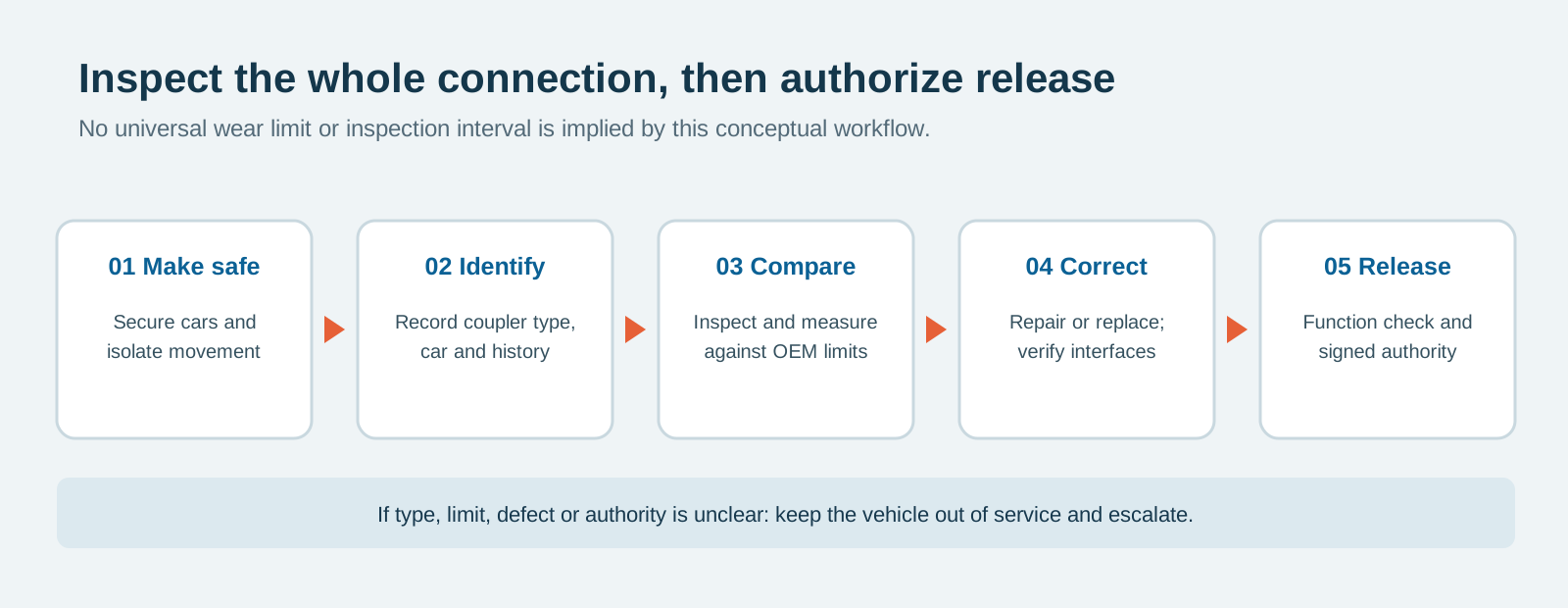
- Secure and identify the vehicles, route and connection type.
- Inspect and measure the whole load path against the correct documents.
- Classify defects and investigate repeat or interface failures.
- Repair or replace with traceable approved parts and controlled methods.
- Verify coupling function and record formal release authority.
How does this become a repeatable fleet program?
Build an asset register that connects each vehicle to its installed coupler family, compatible mates, spare parts, inspection method and controlled wear criteria. Include location and use: a high-use production consist, incline supply cars and shunting equipment may not share the same risk exposure. Set inspection intervals using the manufacturer, mine's rules, operating history and risk assessment, not a universal interval from this article. Ensure people assigned to inspect can identify the correct mechanism and use the proper measurement tools.
Trend defects by part, vehicle pair, route and event. Repeated coupling difficulty or damage should be reviewed with track condition, loading and shunting practice, not filed as independent parts consumption. Keep changed car formations and substitute locomotives under configuration control. This turns the coupler register into a useful procurement and maintenance tool rather than a box-ticking list.
What should a coupling-related RFQ or review package contain?
Provide vehicle and mine-car types, gauge, route curves and gradients, loaded and empty masses, operating method, existing coupler photos and drawings, component IDs, height and mounting dimensions, secondary restraints, failure history and site rules. State whether the need is new rolling stock, a replacement coupling, an upgrade or an inspection plan. A supplier cannot responsibly promise fit from a generic mine-car photograph or nominal wagon capacity.
Request the proposed interface drawing, compatible mating list, maintainable parts, approved inspection method, wear-gauge details, documentation, spare strategy and acceptance responsibilities. ShaoLi's mine-car category and rolling-stock selection guide can help frame an initial equipment discussion; site-specific coupling approval remains with the competent parties and the mine's current controls.
Frequently asked questions
Is inspecting the coupler head enough?
No. Include lock or pin, shank, draft gear, mounts, alignment, mating vehicle and any specified secondary restraint.
What is the universal maximum coupler wear?
There is no universal value in this guide. Use the correct manufacturer's drawing, gauge and acceptance criteria for the installed coupler and mine.
Can two different mine cars be coupled if the heads engage?
Engagement alone does not establish load, height, curve, draft-gear or braking compatibility. Review the complete interface and approved consist.
What if the coupler type or limit cannot be identified?
Keep the result unresolved and escalate for documentation and competent assessment; do not label it serviceable from appearance alone.
Should a temporary safety chain replace a defective coupler?
No generic substitution is safe to prescribe. Apply the mine's approved recovery or secondary-restraint design and keep a defective primary connection out of routine service.
How often should mine-car couplers be checked?
The interval depends on the installed design, manufacturer instructions, mine rules, duty, condition history and risk assessment.
What documentation is needed after repair?
Record vehicle and component IDs, findings, approved criteria, repair parts and method, measurements, functional checks, remaining restrictions and release authority.
Sources & references
- NIOSH archive: Guidelines for Automatic Couplers, Volume II
Historical 1977 US mining study of automatic-coupler design, inspection and maintenance; not a current universal tolerance.
- South African underground rail-bound equipment guideline
Jurisdiction-specific government guidance; check the current mine code and law for any particular project.
- MSHA 2001 coupler-wear investigation
Historical US incident with a specific Willison coupler and gauge; its numerical limits must not be generalized.
- Irwin mining coupler range
Attributed manufacturer example showing multiple coupler and draft-gear families; not evidence of ShaoLi fitment.
- BROOKVILLE mining rail equipment
Attributed supplier example showing vehicle-specific coupler interfaces; not a universal design rule.
Turn the guide into a project requirement
Send the route, train, duty, power, environment and interface data. ShaoLi can review the requirement against relevant product and solution paths without treating a generic guide as a final design.
Request an engineering review