Engineering & Buyer Guide
Underground Mine Rail Track Inspection: A Condition and Maintenance Plan
How should an underground mine organize rail track inspection and maintenance?
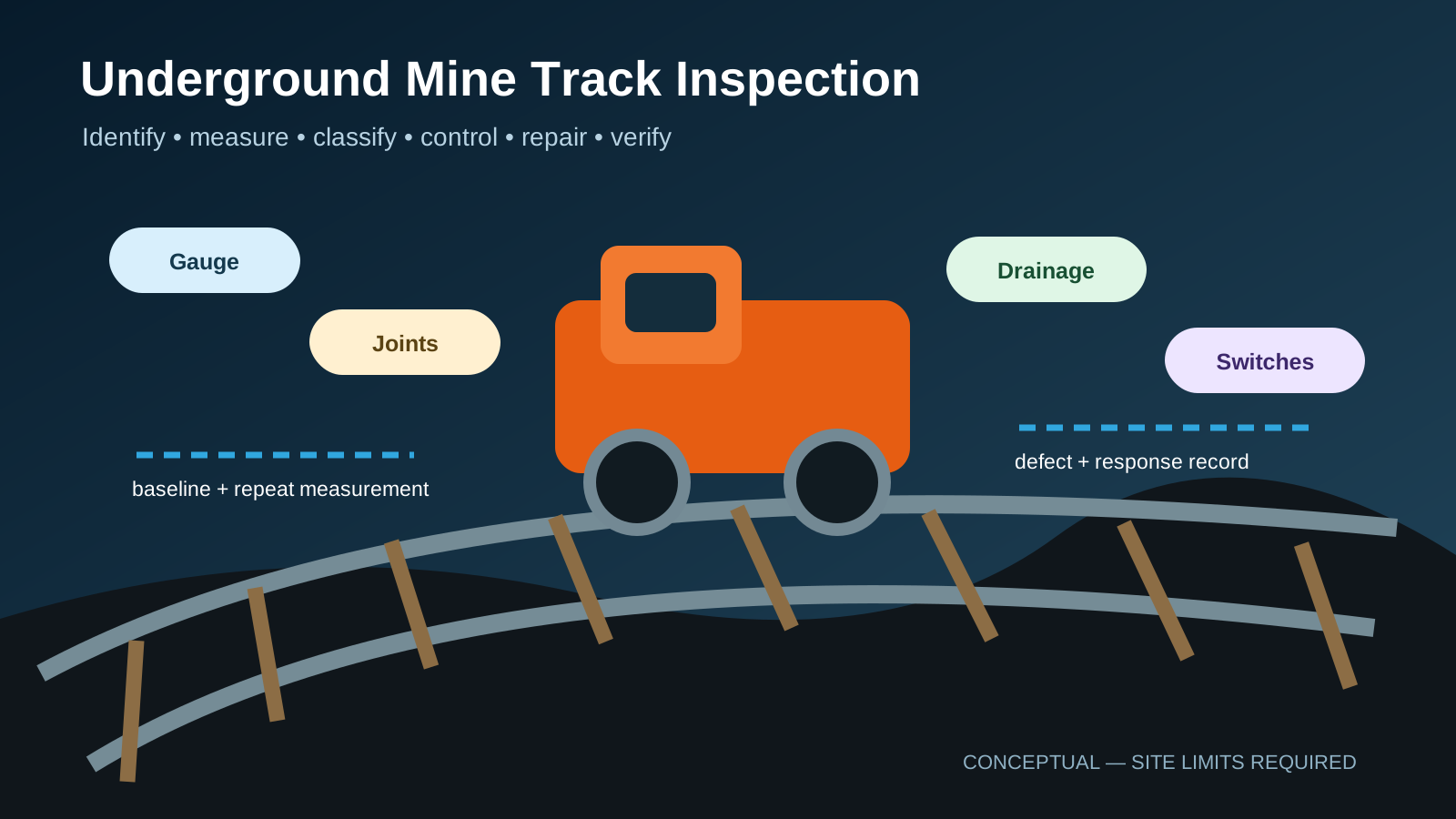
Conceptual condition loop: inspect, classify, control, repair, verify and trend each identified route section.
TL;DR / Direct Answer
How should an underground mine organize rail track inspection and maintenance?
An underground mine rail track inspection plan should convert route condition into controlled operating decisions. Divide the network into identifiable sections, establish an approved baseline, assign inspection frequencies by risk and traffic, measure geometry and component condition consistently, classify defects, set speed restriction or closure authority, repair to controlled criteria and verify the result. Track, wheels, train loading and operating practice interact, so repeated derailment or wear should trigger a system review rather than isolated component replacement.
What belongs inside the track-maintenance system boundary?
Treat the route as more than two rails. The controlled asset includes rails, joints or welds, fastenings, sleepers or other supports, ballast or roadway support, drainage, curves, gradients, transitions, switches and crossings, check rails where used, stop blocks, clearances, signs, isolation interfaces and the environment around the track. Loading pockets, tip areas, doors, cable crossings and workshop approaches deserve explicit identities because contamination and concentrated forces can make them critical.
The HSE guidance on rail track and associated equipment for underground mines links selection, installation and maintenance and explains that track must support vehicle weight plus tractive, braking and lateral forces. Its detailed provisions are for the stated UK scope, but the system principle travels well: track condition cannot be separated from train mass, speed, wheel condition, curvature, braking and support. The site's applicable rules and engineering criteria remain controlling.
| Asset group | Condition questions | Controlled evidence |
|---|---|---|
| Rails and joints | Wear, damage, alignment, joint condition and fastening security | Route-section inspection record |
| Gauge and geometry | Gauge, cross-level, alignment, gradient transition and curve condition | Baseline and repeat measurements |
| Support and drainage | Movement, settlement, voids, contamination and water pathway | Defect map and repair verification |
| Switches/crossings | Fit, movement, locking, wear, obstruction and indication | Functional test and component record |
| Interfaces | Clearance, loading points, doors, cables, pedestrians and work zones | Survey and operating-control register |
How should the route be divided and baselined?
Give every route, branch, curve, switch and special location a stable identifier that appears on drawings, inspection forms, work orders and incident records. Break long routes at physical or operational boundaries so a defect can be found without relying on memory. Record gauge, rail section, support arrangement, curve radius, gradient, design vehicle envelope, approved train and speed for each section. Where information is uncertain, survey it and mark it pending rather than inventing a baseline.
A useful baseline combines measured geometry, dated photographs, component identity and known repairs. It should also record wet zones, recurring contamination, ground movement and access limitations. The baseline is not a declaration that every value is acceptable; it is the reference from which deterioration can be detected. Approve tolerances and intervention limits separately through the mine's engineering and regulatory process.
How should inspection frequency be set?
Use a risk-based schedule informed by traffic, axle loads, speed, gradients, curves, switches, braking zones, water, ground movement, loading spills, recent work and defect history. A frequently used main haulage curve may need more attention than a straight low-traffic siding. Add event-driven inspections after derailment, impact, flooding, roof or civil work, track relocation, abnormal wheel damage or operator reports. The interval should be reviewable when evidence changes.
Separate pre-use or shift observations from periodic detailed inspection and engineering survey. Operators can report obstruction, unusual ride, noise, visible displacement or switch problems, but this does not replace competent measurement. Detailed inspectors need suitable tools, defined methods and authority to impose controls. Engineering review should trend geometry and recurring defects and confirm whether the maintenance strategy remains adequate.
- Rank route sections by consequence, exposure and known deterioration mechanisms.
- Assign routine observation, detailed inspection and survey frequencies.
- Define events that trigger an immediate additional inspection.
- Name the competent role and stop, restrict or close authority.
- Review intervals using defect, derailment, wheel-wear and repair history.
What should a competent track inspection examine?
Walk or otherwise inspect the route under an approved safe system of work. Check rail wear and damage, joints or welds, loose or missing fastenings, support condition, gauge, alignment, cross-level, curve transitions, drainage, mud or material accumulation, clearances and signs. At switches and crossings, check moving parts, fit, locking or indication as applicable, flangeways, wear and obstructions. Record the actual location and condition, not only a pass box.
Measurements must be repeatable. Specify the tool, method, measurement points, calibration or verification needs and units. Photograph defects with a scale and route identifier when useful. Compare against the site's approved limits; do not borrow one numerical tolerance from a different rail system without engineering review. HSE guidance is a valuable structure for the topics to examine, while the mine must approve values appropriate to its vehicles, track form and jurisdiction.
- Rail head, web and foot condition; joints, welds and end batter.
- Gauge, cross-level, alignment and transition through curves and gradients.
- Fastenings, sleepers/supports, ballast or roadway restraint and settlement.
- Switch blades, crossings, check rails, operating mechanism and indication.
- Drainage, contamination, corrosion, clearance and adjacent work damage.
How should defects become operating controls?
Create defect classes tied to an immediate response, responsible owner and maximum closure time. A critical defect may require stopping traffic and physically protecting the section; another may justify a defined speed, load or access restriction until repair. The inspector must know who can impose and remove each control. The control should appear in dispatch or route authority, signage and the defect record so it does not depend on informal messages.
The response matrix should address combinations as well as isolated measurements. Water, loose support and changing geometry together can be more significant than any single observation. Repeated defects at the same location should trigger root-cause review of drainage, ground movement, loading, train forces, wheel condition or installation. Closing a work order after tightening a fastener is not sufficient if the underlying movement remains.
| Stage | Required decision | Record |
|---|---|---|
| Identify | Exact asset, location, condition and measurement | Defect report with evidence |
| Classify | Approved severity and credible consequence | Named class and approver |
| Control | Stop, restrict, monitor or schedule | Dispatch/signage/control confirmation |
| Repair | Method, materials, isolation and competent person | Work order and as-left condition |
| Verify | Reinspect, measure and authorize return | Independent or assigned verification |
| Trend | Recurring location or system cause | Monthly/periodic engineering review |
How do locomotive and rolling-stock findings improve track maintenance?
Track and vehicles form one running system. Trend wheel flange and tread wear, axle or bearing findings, suspension condition, collector behavior where trolley power is used, coupler events, ride complaints, wheel slip, braking irregularities and derailments by route section. Similar wear across several vehicles can point toward track geometry or operating practice; a single-vehicle pattern may point toward the vehicle. Investigation should keep both possibilities open.
Control changes to approved consist mass, axle load, wheel profile, speed and locomotive type. A route accepted for one configuration is not automatically suitable for a heavier or different vehicle. Before introducing new rolling stock, compare gauge, wheel/rail interface, dynamic envelope, curve negotiation, braking and route support. Feed acceptance and maintenance findings back into the route register.
What makes a track repair complete?
Plan the repair with the same discipline as inspection. Identify the controlled drawing or method, materials and components, isolation and traffic protection, ground or drainage work, competent roles, measurement method and acceptance values. Protect cables, services and nearby equipment. Temporary repairs require an expiry, inspection frequency and permanent-action owner; otherwise they become undocumented permanent conditions.
After work, inspect and measure the affected section and its transitions. Confirm fastenings, geometry, switch function, drainage and clearance, then complete any approved low-speed or loaded proving movement. Record as-left values and who authorized return to service. Update the baseline when the configuration changes. Remove restrictions only through the named process and communicate the release to dispatch and operators.
What should the annual track condition plan contain?
The plan should connect asset register, risk rank, inspection schedule, competent-person requirements, tools, defect response, work planning, spare materials, capital renewals and performance review. Budget for drainage and support correction as well as rail and switches. Define lead indicators such as overdue inspections and open high-priority defects, plus outcome indicators such as derailments, restrictions, repeat repairs and wheel-wear trends.
Review the plan after significant incidents, route changes, production increases or introduction of new vehicles. Use inspection and work-order data to identify sections where recurring corrective work is more expensive than renewal. An RFQ for track support or locomotive service should include route drawings, approved trains, defect trends and interface responsibilities. ShaoLi can support locomotive and rolling-stock interface review, while the mine retains responsibility for route engineering, operation and local compliance.
- Controlled route and asset register with stable location identifiers.
- Risk-ranked routine, detailed and event-triggered inspection schedule.
- Site-approved measurement limits and defect response authority.
- Work-order, repair verification and restriction-release workflow.
- Vehicle-condition, incident and repeat-defect trend review.
- Renewal priorities, resources, competencies and audit evidence.
Frequently asked questions
How often should underground mine track be inspected?
Set intervals from traffic, axle load, speed, curves, gradients, switches, water, ground movement, work history and applicable rules. Add immediate event-driven inspections after relevant incidents or changes.
Can operators perform the complete track inspection?
Operators are valuable for routine observations and reporting, but detailed measurement and engineering review require assigned competent roles, approved methods and authority.
What is the most important track measurement?
There is no single sufficient measurement. Gauge, alignment, cross-level, support, rail and joint condition, switches, drainage and clearance interact with the approved vehicles and operation.
When should a track section be closed?
The mine must define site-approved defect classes and authority. Inspectors need a clear route to stop traffic immediately when a condition meets the critical class or creates uncertain safe passage.
Does replacing damaged rail close the defect?
Only after the repair and transitions are inspected, measured and accepted, the root cause is considered, records are updated and any restriction is formally released.
How are wheel wear and track condition connected?
Wheel profile, rail geometry, curves, loading, speed and maintenance interact. Trend vehicle findings by route and investigate repeated patterns without assuming the cause is only track or only vehicle.
Can HSE track tolerances be copied for every mine?
No. Use the guidance within its stated scope and as a prompt. The project must approve limits for its track form, vehicles, risk assessment and jurisdiction.
Sources & references
- HSE Rail track and associated equipment for use underground in mines
Primary UK guidance on track selection, installation, inspection and maintenance; scope limitations are retained.
- HSE mining publications and guidance
Current regulator index used to verify publication context.
- SAIMM Track maintenance management system
Industry paper used for inspection-record and condition-management concepts, not as a statutory source.
- NSW Mining Design Guideline: braking systems
Primary regulator context for braking-system risk that interacts with route condition; NSW scope applies.
- MSHA powered haulage safety materials
US regulator incident-prevention context; site rules and mine type still control.
Turn the guide into a project requirement
Send the route, train, duty, power, environment and interface data. ShaoLi can review the requirement against relevant product and solution paths without treating a generic guide as a final design.
Request an engineering review