Development trends of the underground mining locomotive industry
Development trends of the underground mining locomotive industry
In the past two years (2024–2026), spurred by the explosive growth of artificial intelligence and the global mining industry's transition toward green and low-carbon operations, the underground mining locomotive sector (including auxiliary transport locomotives, electric locomotives, suspended monorails, etc.) has undergone an unprecedented transformation. The traditional "clunky, crude, and dirty" scenes of underground mining are rapidly being replaced by a modern vision characterized by "safety, intelligence, and sustainability."
Underground auxiliary transportation and ore haulage have always been the most arduous and high-risk links in mining operations. Over the past two years, the core axis of the industry's development can be summarized by two main themes: new energy transition and autonomous driving.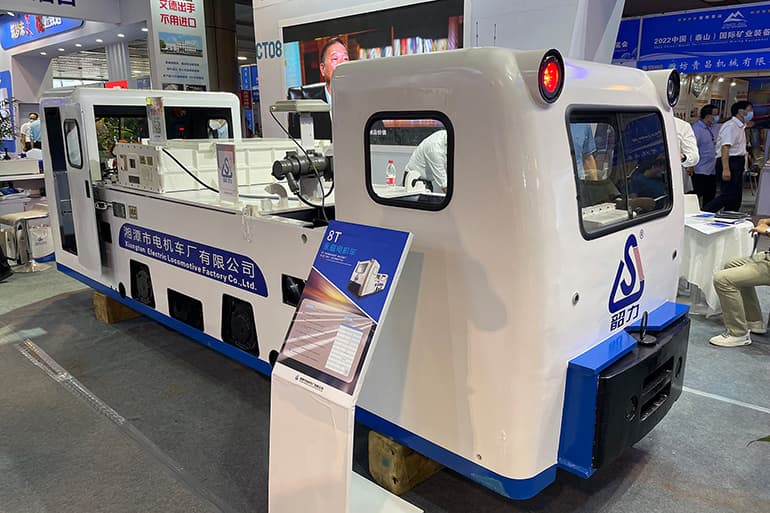
1. Policy Guidance: Top-Level Design Forces "Fewer Workers for Greater Safety" and Accelerates Intelligent Upgrades
Mandatory policy requirements have been the biggest driver behind the upgrade of underground locomotives over the past two years. Facing difficulties in recruiting workers for underground mines, a severely aging workforce, and the high risk of occupational diseases, the government has pressed the "fast-forward button" on intelligent upgrades from a policy level.
Clear Timetables and Penetration Rate Requirements: In April 2024, seven departments, including the National Mine Safety Administration (NMSA), jointly issued the Guiding Opinions on Deepening the Intelligent Construction of Mines and Promoting Safe Mine Development. It explicitly proposed that by 2026, a complete intelligent mine standard system must be established, and the proportion of intelligent production capacity in coal mines nationwide should be no less than 60%.
"AI + Mining" Becomes a Mandatory Requirement: With the explosion of large AI models like DeepSeek in 2025, "AI+" applications have accelerated their implementation in energy and mining scenarios. Policies explicitly encourage the use of AI technologies to promote workforce reduction and unmanned mining operations, realizing the goal of "fewer workers for greater safety" .
Intensive Rollout of Local Standards and Regulations: Around 2025, major energy-producing provinces successively introduced local standards. For instance, Shanxi and other regions issued the Technical Specification for Intelligent Management of Auxiliary Transportation Systems in Underground Coal Mines (DB 14/T 3546—2025), which set specific technical requirements for the automatic control, signal coordination, and unmanned material dispatch of underground locomotives.
2. Technological Evolution: From "Single-Machine Automation" to "Full-Domain Unmanned Operation and Pure Electrification"
Underground locomotive technology achieved leapfrog breakthroughs between 2024 and 2025, especially in deep underground spaces lacking GPS signals.
Pure Electrification and Ultra-Fast Battery Swapping: Traditional explosion-proof diesel locomotives are being rapidly phased out due to high emission pollution and noise. From 2025 to 2026, pure electric drives coupled with fully automatic fast battery swapping have become the new standard. For example, newly deployed cabinless unmanned battery-swapping mining vehicles support fully automatic battery swaps in 3 to 5 minutes, enabling 24-hour continuous operation. A single vehicle can save up to 700,000 RMB per month in operational and energy costs (with energy costs dropping by over 50%).
Normalization of Underground L4 Autonomous Driving: While autonomous driving in open-pit mines has already matured, over the past two years, the technological focus shifted entirely underground. Utilizing 5G, F5G intrinsically safe hard pipes, multi-sensor fusion (LiDAR, millimeter-wave radar, etc.), and digital twin technology, large mines like Jinchuan Group have achieved smooth autonomous driving of electric locomotives at a depth of one thousand meters, establishing a fully unmanned closed-loop operation for the entire "loading-transport-unloading" process.
Unified Protocols and Fleet Coordination (Platformization): In the past, severe data silos existed among locomotives, monorails, and trackless rubber-tired vehicles from different manufacturers. Today, based on unified operating systems and communication protocols like MineHarmony, underground transportation networks have achieved system-level intelligent integration. Just a few dispatchers in the surface command center can now manage dozens of underground locomotives, completely transforming the labor-intensive "four shifts, three rotations" model of the past.
3. Market and Commercial Landscape: A Dual-Track Approach of Scaled Implementation and "Going Global"
After early-stage technological validation, the commercialization of underground mining locomotives and their accompanying unmanned systems ushered in a large-scale explosion (a watershed moment) in 2025.
| Dimension of Comparison | Traditional Underground Mining Locomotive Era | 2025–2026 Intelligent Locomotive Era |
| Energy & Drive | Explosion-proof diesel, traditional lead-acid batteries; high maintenance costs. | Pure electric, 3-5 min automatic fast charging/battery swapping; zero emissions. |
| Driving Mode | Manual driving; high labor intensity, harsh environments causing fatigue. | 5G remote control, normalized L4 autonomous driving. |
| Operational Efficiency | Single-machine operation; relies on manual dispatch and communication. | Coordinated fleet dispatch; effective daily operation can reach 22 hours. |
| Personnel Staffing | Labor-intensive; extremely difficult to recruit workers. | Data-driven; manpower demand drastically reduced by over 70%. |
Large SOEs Lead, Private Mines Follow: Currently, large state-owned mining areas like China Energy (CHN Energy) have taken the lead in completing closed-loop operations for autonomous driving and intelligent auxiliary transportation. Meanwhile, private mines—which account for over 85% of the total number of mines in China—are undergoing an upgrade phase from mechanization to intelligence, providing a massive incremental market for locomotive equipment suppliers.
"Going Global" Becomes a New Growth Pole: Domestic mining equipment and autonomous driving solution providers (such as XCMG Mining Machinery, EACON, and Bolei Tech) are actively exporting their comprehensive "pure electric unmanned mining truck/locomotive and battery swapping station" solutions overseas. By early 2026, the first pure electric unmanned transportation demonstration projects built by Chinese enterprises had already been deployed in overseas mining areas, such as those in Indonesia.
4. Challenges and Future Outlook
Despite the rapid development, the industry still faces several objective bottlenecks:
Challenges of the Harsh Underground Environment: High temperatures, high humidity, and heavy dust underground remain a severe test for the lifespan and accuracy of precision sensors (such as cameras and LiDAR) on the locomotives.
High Initial Retrofitting Costs: Intelligence means more than just buying an unmanned locomotive; it also requires the accompanying modernization of underground 5G networks, cloud control platforms, and standardized roadways. The large upfront capital investment poses a breakeven challenge for some small and medium-sized mines.
Outlook:
By 2030, with the decline in sensor costs and the enhancement of AI generalization capabilities, underground mining transportation will fully achieve "unmanned and lights-out" (fully automated) operations. The role of equipment manufacturers will shift from simply "selling vehicles" to becoming comprehensive solution providers offering "transportation capacity services + comprehensive intelligent mine management and control platforms."