The definitive future of underground mining locomotives
1. Policy Red Lines: "Safety Through Unmanned Operations" Shifts from Slogan to Hard Demand
Over the past two years, the focus of mine safety policies has fundamentally shifted from "reducing casualties" to "zero casualties (unmanned/reduced-staff operations)." Intelligent transformation is no longer an "optional extra" for mining enterprises but a "mandatory requirement" and a baseline for survival.
Intensive Rollout of Top-Level Designs: In early 2024, the Ministry of Emergency Management (MEM) and the Ministry of Industry and Information Technology (MIIT) jointly issued the Guiding Opinions on Accelerating the Development of Emergency Robots. Subsequently, multiple departments, including the National Energy Administration (NEA), issued further guidelines for intelligent mine construction, explicitly requiring the establishment of single or multiple intelligent systems by the end of 2025, and encouraging large coal mines to comprehensively advance the intelligent transformation of major production links.
Implementation of Group and Industry Standards: As group standards like the Safety Operation Requirements for Autonomous Driving in Open-Pit Coal Mines entered substantive review and publication between 2025 and early 2026, their influence is rapidly extending to the more complex underground mining environments. This establishes national-level norms for equipment interfaces, safety protocols, and V2X (Vehicle-to-Everything) communication standards.
Dual Pressure from Environmental Protection: Increasingly strict environmental policies, such as dust emission limits, are forcing mining enterprises to complete the phase-out and replacement of old explosion-proof diesel locomotives within a short cycle.
2. Powertrain Revolution: The Exit of Explosion-Proof Diesel and the Explosion of Pure Electrification
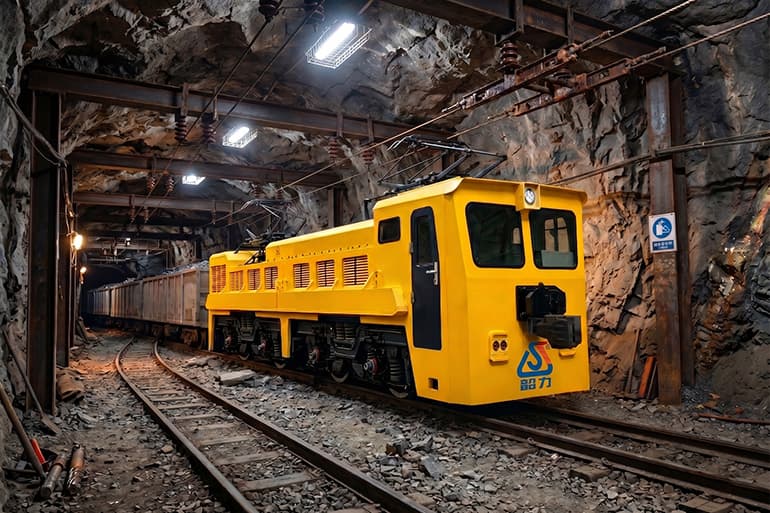
In confined underground spaces, the high temperatures, exhaust emissions, and deafening noise generated by traditional explosion-proof diesel locomotives have long been critical pain points. Around 2025, pure electric vehicles (pure electric mining trucks/electric locomotives) became the absolute mainstays of the new generation of mining locomotives.
Breakthroughs in Ultra-Fast Charging and Battery Swapping: Modern pure electric underground locomotives have not only achieved zero exhaust emissions but also made significant strides in control strategies (e.g., regenerative braking and autonomous charging/swapping dispatch). Fully automatic, cabinless battery-swapping solutions introduced by leading enterprises have compressed replenishment times to just 3-5 minutes, perfectly aligning with the demands of continuous, high-intensity underground operations.
Emergence of TCO (Total Cost of Ownership) Advantages: Relying on the cost differential between electricity and fuel, combined with the elimination of high wages for underground drivers, the return on investment (ROI) cycle for pure electric unmanned locomotives has been drastically shortened.
3. Navigation and Control Leaps: Conquering the "GPS-Denied" Underground Labyrinth
Underground mines lack GPS signals, feature narrow roadways with numerous branches, and suffer from poor lighting—these have long been technological blind spots hindering the unmanned operation of underground locomotives. However, over the past two years, the maturation of multi-sensor fusion and dedicated underground networks has broken this bottleneck.
The "One Network" of 5G + Edge Computing: Industry leaders have begun to deploy a unified network architecture on a massive scale characterized by "one card, one number, one network, one station, and one cabinet." By deploying underground 5G base stations, Wi-Fi 6, and integrated edge clouds, end-to-end network coverage with high bandwidth and low latency has been achieved, resolving the past chaos of "multiple networks in one mine" and highly fragmented systems.
Deployment of Full-Stack L4 Autonomous Driving: Tech companies (such as Bolei Tech, EACON, and Huawei) have specifically optimized algorithms for underground scenarios. Relying on the deep coupling of LiDAR, millimeter-wave radar, and machine vision, paired with 3D high-definition maps built via underground digital twins, locomotives can now routinely achieve autonomous obstacle avoidance, precise docking, and automatic unloading at depths of one thousand meters.
4. Commercial Model Restructuring: From "Single-Machine Sales" to "Exporting Smart Solutions"
As technology matures, the landscape of market competition has also undergone a massive shift. The role of equipment manufacturers is fundamentally transforming.
System-Wide Coordinated Dispatch: Future underground mining locomotives will no longer be isolated entities, but rather intelligent nodes within the Smart Mine Internet of Things (IoT). The surface dispatch center can simultaneously manage dozens of unmanned locomotives across platforms, achieving full integration with the mining face, hoists, and ventilation systems. This results in an exponential leap in overall operational efficiency.
Exporting Technical Solutions: The first-mover advantages of Chinese enterprises in the fields of new energy mining equipment and autonomous driving are rapidly transforming into international competitiveness. Entering 2026, an increasing number of Chinese "pure electric + unmanned" full-domain smart solutions are being exported to overseas mining areas in Indonesia, Africa, and South America, actively seizing the initiative to define global industry standards.
In summary, the future of the underground mining locomotive industry represents a technological leap transitioning from being "strongly driven by policy" to being "spontaneously driven by commercial value." The underground roadways of the future will undoubtedly be a safe, green space operating efficiently under a "smart fleet" characterized by pure electrification, unmanned operations, and coordinated fleet dispatch.