Engineering & Buyer Guide
Mining Locomotive Spare Parts Preservation: Receiving, Storage and Release Controls
How should a mine preserve locomotive spare parts from receipt until controlled issue without mistaking stock on a shelf for an approved, serviceable replacement?

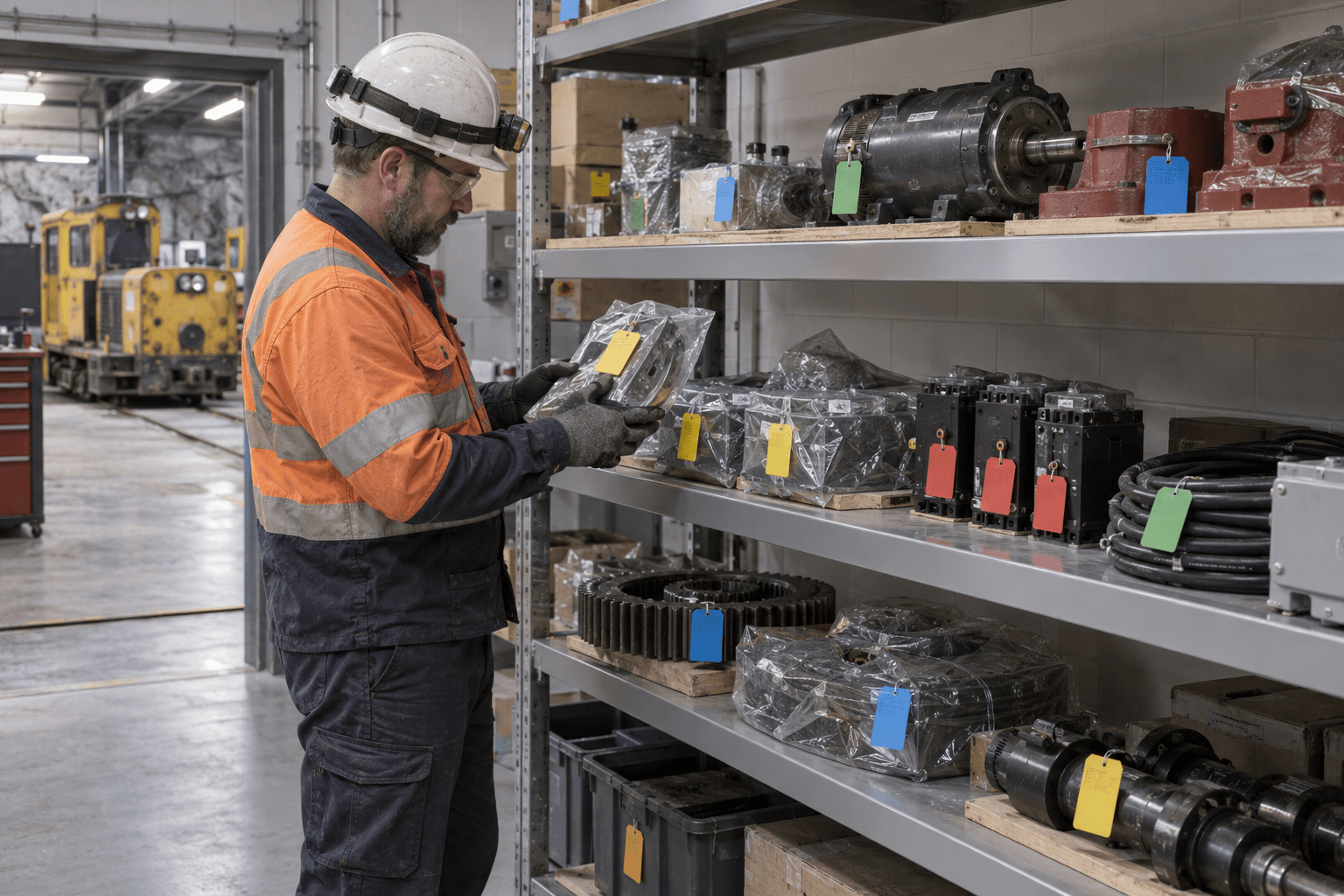
Illustrative industrial scene. It is not a ShaoLi facility, customer site, inventory record, compatibility decision, inspection record or certification evidence.
TL;DR / Direct Answer
How should a mine preserve locomotive spare parts from receipt until controlled issue without mistaking stock on a shelf for an approved, serviceable replacement?
Treat a spare as available only when its identity, condition, preservation status and approval path are visible. Receive it against a controlled order, quarantine anything uncertain, apply the exact manufacturer storage instructions, inspect it at defined triggers, and verify the vehicle and revision again before issue. This process protects a previously approved part from becoming unusable or untraceable in storage; it does not prove interchangeability, set a universal shelf life or promise that any ShaoLi part is currently in stock.
Separate preservation from criticality and compatibility
Three different decisions are often compressed into one stock status. Criticality asks whether an outage consequence and realistic recovery time justify holding a part. Compatibility asks whether an exact component or controlled substitute can be fitted to a defined locomotive configuration. Preservation asks whether the approved item has remained identifiable and within its required condition from receipt to issue. Passing one decision never automatically passes the other two.
The existing mining-locomotive spare-parts planning guide addresses criticality, quantity and interchangeability. This guide starts after a purchase or transfer has been authorized. Its purpose is to prevent identity loss, corrosion, contamination, aging, damaged packaging, missed maintenance actions and uncontrolled issue. Component-specific limits must come from the current supplier documentation, project requirements and mine procedure; this page deliberately supplies no generic temperature, humidity or time limit.
| Decision | Question | Required evidence | What it does not prove |
|---|---|---|---|
| Criticality | Should the mine hold this item? | Failure consequence, approved contingency and end-to-end recovery time | Fit, condition or release |
| Compatibility | May this exact item serve this configuration? | Vehicle and component identity, revision, interfaces and controlled approval | That the stored item remained serviceable |
| Preservation | Has the approved item remained controlled until issue? | Receipt condition, storage instruction, inspections, status and traceability | Installation acceptance or return to service |
Receive against identity and condition, not the delivery note alone
Receiving should connect the physical item to the purchase requirement before it enters usable stock. Record the supplier, order line, description, part number, revision, serial or batch where applicable, quantity, packaging condition, accompanying documents and intended vehicle or assembly. Photographing an unidentified box is not traceability. If the order allowed a substitute, the approval reference should travel with the item instead of living only in an email inbox.
Quarantine is a status, not merely a shelf. Use it when identity, condition, documentation, preservation instructions or approval is incomplete. Mark the physical item and the inventory record consistently, control access and assign an owner and next action. Do not let schedule pressure convert a candidate part into usable stock. A stores team can confirm what arrived; engineering and the mine's accountable process decide whether a changed or repaired component is acceptable for a particular configuration.
- Match the physical identity and revision to the controlled order and approval reference.
- Record transit or packaging damage before removing protective material unnecessarily.
- Confirm that manuals, certificates or test records refer to the delivered item rather than a product family.
- Assign usable, quarantined, inspection-due, repairable or rejected status through the mine's process.
- Create an owner and due action for every discrepancy; do not hide it in a free-text note.
Build a part-specific preservation plan
The preservation record should cite the source of each instruction. Depending on the component, the supplier may specify packaging, orientation, lifting points, contamination protection, corrosion prevention, environmental range, periodic rotation or energization, inspection, battery care, seal protection or a maximum storage interval. Those actions are not interchangeable. Applying a convenient generic warehouse practice can damage the item or erase evidence needed for later acceptance.
Separate the storage zone from the item requirement. A room may be called dry or climate controlled, but the useful evidence is the monitored condition, alarm or excursion record and the affected stock list. Heavy assemblies also need verified support, safe lifting access and protection from impact. Electronic modules need controlled handling and connectors protected from dirt or damage. Elastomers, lubricated assemblies and energy-storage components can have different aging mechanisms, so one preservation checklist should route to specific instructions rather than invent one universal treatment.
| Field | Decision value | Evidence source |
|---|---|---|
| Identity and applicability | Prevents a similar-looking item from entering the wrong stock code | Order, drawing, supplier cross-reference and approval |
| Packaging and protection | Shows the required barrier, caps, supports or corrosion protection | Current component instruction |
| Storage environment | Connects the item to a suitable zone and excursion response | Supplier requirement and site monitoring |
| Timed actions | Makes inspection or preservation work visible before it is missed | Manufacturer interval or approved local plan |
| Status and owner | Prevents automatic issue while a condition or document is unresolved | Mine inventory and maintenance process |
Make stock status visible in the system and on the item
A quantity greater than zero says nothing about serviceability. The same stock code can contain an unopened approved item, a returned component awaiting assessment, an expired preservation action, a repaired unit without its test record and a candidate substitute awaiting review. Give each serialized item or controlled batch a status that blocks inappropriate issue. Where the inventory system is limited, use a governed supplementary register rather than an informal color tag with no definition.
Define who may change status and what evidence is required. Receipt staff may place an item in quarantine, but release to usable stock may require document review, condition inspection or engineering confirmation. An inspection-due item should not revert to usable because the physical tag fell off. Reconcile system and physical status during cycle counts, after a storage excursion and before planned work. Record dates, observations and actions without manufacturing false precision about remaining life.
Engineering note: A color, barcode or bin location is only a pointer. The controlled record must explain the status, evidence, owner, restriction and next review trigger.
Control shelf life, revision change and obsolescence without guessing
Not every spare has a published shelf life, and storage time is not the same as installed service life. Ask the supplier which date starts the clock, which conditions the limit assumes, whether inspection or re-preservation changes the status, and what evidence is required. If no limit is available, record that gap and obtain a decision; do not invent a period or silently treat indefinite storage as approved. First-in-first-out is useful only among items that remain equivalent and usable.
Obsolescence can be documentary as well as physical. A new controller revision, changed connector, firmware dependency, brake material or drawing update can leave a preserved part incompatible with the active fleet. Review stock when the fleet configuration changes, a supplier issues a replacement reference, a repair experience reveals an interface difference, or a project transfers parts between sites. Keep superseded and superseding identities visible until engineering has decided disposition for each affected configuration.
Use a final issue gate before the component reaches the job
The issue gate repeats the facts most likely to have changed since purchase: receiving status, current part and revision, intended locomotive or assembly, preservation actions, packaging and physical condition, required documents, and any time- or condition-based restriction. It also checks that the planned work has the correct procedure, tools, competent people and post-installation test route. Stores release and equipment return to service remain separate approvals.
If the installation team finds a mismatch, preserve the evidence and return the item through a defined process. Do not relabel it as an equivalent part to clear the transaction. Record the as-found condition, reason for return and whether protective packaging must be restored. When an approved component is installed, update the vehicle configuration and inventory history with its serial or batch where relevant so future diagnosis and replenishment use the as-fitted record.
- Select the intended vehicle, assembly and approved work scope.
- Verify the physical part, revision, serial or batch and approval reference.
- Confirm preservation actions, storage history, packaging and present condition.
- Check that required instructions, tools, competencies and acceptance tests are available.
- Issue to the job with traceability, or quarantine the item and assign a discrepancy action.
- After installation, update the as-fitted configuration, test evidence and replenishment record.

Keep returned, repairable and rejected parts out of usable stock
A removed component can carry contamination, hidden damage, stored energy or an unresolved failure mode. Identify its source vehicle, removal reason and handling restrictions before it enters a returns area. A repairable status should identify the approved repair route, specification, service provider, required test and acceptance evidence. Until those gates are passed, it is not an available spare even if it looks complete.
Disposition also needs control. Parts retained for failure analysis, training, salvage or disposal should not share an unrestricted location or stock status with usable components. Remove or cancel identifiers only through the approved process, preserve chain of custody where investigation requires it, and follow environmental and hazardous-material requirements for the actual component. This article does not prescribe disposal methods because battery, electronic, oil-containing and mechanical assemblies may be governed differently.
What should a preservation-focused parts enquiry contain?
Send the locomotive model and serial, fitted assembly and revision, requested part identity, destination, expected storage period and environment, handling constraints, documentation language and the mine's receipt and acceptance needs. Ask the supplier to state packaging, preservation, transport, storage, inspection and expiry or review requirements for the quoted item. Require deviations and candidate substitutes to be explicit rather than hidden behind a generic description.
ShaoLi's accessories page is a route to a project-specific discussion, not a live inventory promise. The enquiry should ask what can be supplied for the identified configuration and what evidence accompanies it. Availability, compatibility and preservation instructions must be confirmed in the resulting controlled offer and technical documents. Company credentials, category photographs and this general guide cannot approve a part for installation.
- Vehicle, assembly, part, revision and serial or batch evidence available to the buyer.
- Requested quantity and the separate criticality basis from the mine's stock plan.
- Destination, transport exposure, storage environment and estimated storage duration.
- Required packaging, lifting, preservation, inspection, test and document deliverables.
- Named approval route for substitutions, repairs, deviations and final release.
Frequently asked questions
Does stock in the warehouse mean a locomotive spare is ready to use?
No. The item also needs verified identity, approved applicability, acceptable condition, completed preservation actions and a controlled issue status.
What shelf life applies to mining locomotive spare parts?
There is no universal period. Obtain the exact component instruction, starting date, storage assumptions, inspection requirements and disposition rule from the responsible supplier and mine process.
Can first-in-first-out control every spare?
Only among items that remain equivalent, approved and serviceable. Revision changes, condition, preservation status and component-specific limits may override receipt order.
Who can release a quarantined spare?
The mine's controlled process should name the accountable role and required evidence. Stores, engineering, maintenance and supplier review may each have different responsibilities.
Can a repaired component return directly to usable stock?
Not automatically. Identify the repair specification, provider, test results, configuration applicability and acceptance authority before changing its status.
Does sealed packaging prove that the part is preserved?
No. Confirm packaging condition, the specified barrier or protection, storage history, timed actions and the component's current identity and status.
Can ShaoLi confirm a part from a photograph?
A photograph can support identification but cannot prove fit or approval. Provide vehicle and component identities, revisions, interface information and the required operating context for review.
Sources & references
- IAEA TECDOC-2084: ageing management and spare-parts considerations
Cross-industry public guidance that treats storage and maintenance as part of spares management; it is not a mining-locomotive requirement.
- Schalke after-sales service
Attributed OEM example of parts/logistics and lifecycle support; no service or availability claim is transferred to ShaoLi.
- Brookville parts and services
Attributed OEM context for parts and obsolescence support; it does not establish compatibility with another manufacturer's equipment.
- Clayton Equipment public company brochure
Attributed public after-sales and spare-parts context; buyer-specific terms require confirmation.
- Epiroc Reman Program handbook
Manufacturer-specific lifecycle and component context; Epiroc conditions apply only to its program.
Turn the guide into a project requirement
Send the route, train, duty, power, environment and interface data. ShaoLi can review the requirement against relevant product and solution paths without treating a generic guide as a final design.
Request an engineering review