
Engineering & Buyer Guide
Mining Locomotive Spare Parts Planning: Criticality, Interchangeability and Stock Decisions
Which mining locomotive spare parts should a mine hold, and how can it verify that stocked parts will fit?
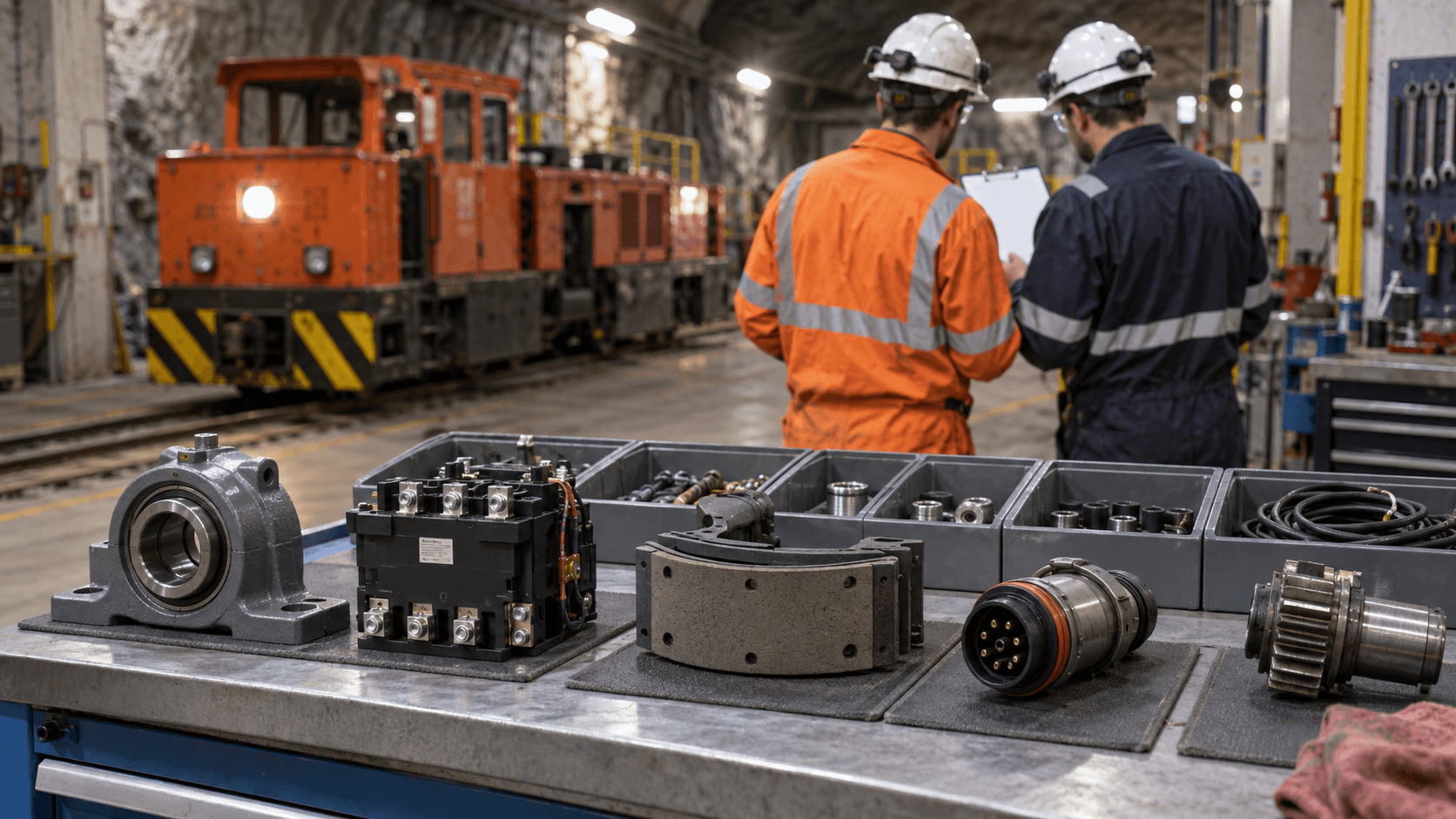
AI-generated illustration, not a ShaoLi facility, documented inventory or customer repair.
TL;DR / Direct Answer
Which mining locomotive spare parts should a mine hold, and how can it verify that stocked parts will fit?
Stock the parts whose absence would create an unacceptable outage or safety exposure and whose recovery time exceeds the mine's approved contingency—not simply the parts bought most often. First identify the actual locomotive and fitted revision. Then rank consequence, lead time and alternatives, verify interchangeability, and approve a quantity with a review date. A photograph, generic part name or shared rating does not prove that a replacement is safe to fit.
What decision should the spares plan make?
The objective is recoverable haulage, not the largest possible storeroom. A useful plan tells operations which failure would stop a safety-critical or production-critical movement, how quickly an approved replacement could be fitted, and which temporary operating mode is actually authorized. Procurement then turns that evidence into stock classes, replenishment actions and a configuration-controlled bill of materials. Without a vehicle-specific baseline, an apparently full storeroom can still leave a mine unable to repair its active fleet.
Separate part criticality from part consumption. A rarely used control component may need immediate local availability if no safe bypass exists and external supply is slow. Conversely, a frequently consumed, standard item with a verified short supply route may not justify excessive holding. Record the reason for each class and its owner. Do not turn this article into a universal min/max quantity: fleet size, operating hours, geography, supplier lead time and contractual support differ from mine to mine.
| Stock decision | When it may be justified | Evidence before approval |
|---|---|---|
| Hold on site | Unacceptable outage or safety consequence; no approved workaround; long recovery | Vehicle/part identity, fitted revision, lead time and approved storage method |
| Shared regional reserve | Several compatible vehicles or sites can access a controlled pool | Documented interchangeability, access rights and realistic transport time |
| Order on demand | Low consequence or approved alternative and short verified replenishment | Supplier commitment, contingency and periodic review |
| Do not stock yet | Identity, fit or approval remains unresolved | Engineering comparison and release before purchase or fitment |
Which asset and failure facts belong in the baseline?
Start at each vehicle, not a supplier catalogue. Capture manufacturer, model, serial number, as-built drawing revision, propulsion type, controller revision, brakes, running gear, couplings, installed battery or current-collection arrangement and modifications. Link every stocked component to the exact assembly, part number, revision, quantity per vehicle and controlled alternatives. Include vehicle location and access constraints: moving a heavy part through a restricted decline can dominate the repair time even if the item is already in the store.
Collect maintenance work orders, failure modes, repair duration, repeat defects, current stock, emergency freight history and actual supplier quotations. Distinguish a proven recurrent failure from a small sample of anecdotes. A single breakdown may justify a risk review but does not establish a statistical failure rate. Ask operations to identify any route or production constraint that changes the consequence of downtime. Record assumptions and data quality; the next engineer should be able to see why a part was classified as critical.
How should consequence and recovery be ranked?
Use an ordinal workshop matrix that the mine can defend. For each failure mode, describe the hazardous or operating consequence, ability to isolate the fault, permitted contingency, number of affected vehicles, access time and repair skill. Then add the realistic end-to-end recovery time: diagnosis, approval, supplier response, transport, customs where relevant, site delivery, installation and verification. An item with a two-day dispatch promise can still be a long-outage risk if documentation or site access is missing.
Keep safety and production consequences visible as separate columns. Do not average away a serious safety concern with a low purchase price. The mine's competent risk process determines whether a vehicle is isolated, restricted or operated under an approved alternative. The storeroom cannot authorize a bypass. Review the ranking whenever a route, fleet, duty cycle, supplier agreement or equipment revision changes. This is an engineering and operations decision that purchasing implements, not a price-only optimization.
- State the specific failure mode and affected train duty, not merely the spare name.
- Record actual contingency and who authorizes it; write 'none' if no approved alternative exists.
- Calculate recovery from first diagnosis to documented release, not warehouse dispatch alone.
- Keep safety consequence and business interruption separately visible.
- Assign a review owner and change trigger to every critical-stock decision.
Why can an apparently identical part still be wrong?
Part numbers can hide design revisions, firmware, connector keys, mounting changes, material substitutions, control settings or changed approvals. For a traction or braking component, request a written cross-reference for the original and proposed item, dimensional and electrical interfaces, software or parameter dependencies, environmental construction and the affected test method. Verify the complete assembly interface, not only a shared power rating or similar appearance. The motor replacement guide addresses that one component's deeper engineering acceptance; this page controls the fleet-wide inventory decision.
Maintain three separate labels: exact approved part, approved controlled substitute, and candidate awaiting review. An unverified candidate should be quarantined in the system and physically marked so urgency does not turn it into an accidental installation. If a part is repaired or refurbished, identify who performed the work, which specification and test record apply, and whether the site accepts that route. Do not claim a component remains certified for a classified area without the exact applicable documents and approval route.
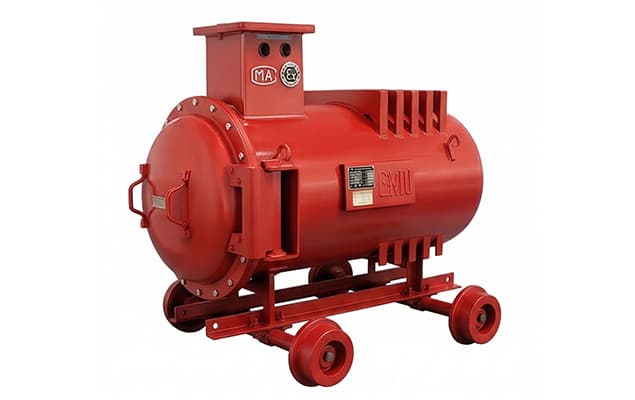
Engineering note: No catalogue picture or generic naming convention is an interchangeability certificate. Use the vehicle-specific OEM drawings, project approvals and competent review.
How can the mine set quantities without a false universal formula?
Use a scenario calculation rather than a copied industry number. For each approved part, compare credible demand during replenishment with the tolerated outage and current buffer. The mine can model normal repairs, one common-cause event, planned overhauls, supplier interruption and transfer between sites. Document the actual lead-time distribution if available; if data is weak, state the uncertainty and obtain a supplier service commitment before assuming an emergency delivery. Reassess after the first operating cycle rather than allowing a spreadsheet quantity to become permanent policy.
Also examine storage consequences. Batteries, electronic modules, bearings and elastomeric parts can have different handling, preservation, inspection and shelf-life needs specified by the manufacturer. A part held locally but not kept within its required conditions may be unusable when needed. Define issue/return controls, serial or lot traceability and periodic condition checks. For high-value assemblies, compare a pooled spare, repair exchange, OEM-held reserve and direct local stock using the same recovery timeline and contractual evidence.
What is the controlled purchase-to-release workflow?
Create one traceable line from failure mode to asset ID, approved stock code, supplier order and fitment record. At purchase, state the drawing revision, approved substitute list, tests, preservation, documentation and packaging. At receipt, compare the delivered identity to the order and inspect condition; do not book a mismatched part into unrestricted inventory. During installation, the mine's qualified team follows its isolation, lifting and test procedures and records as-found and as-left conditions.
After fitting, retain vehicle ID, component serial or batch, installer, drawings, configuration changes, test criteria, measured results, unresolved deviations and release authority. Feed any unexpected interface issue back into the stock code and procurement notes. That loop prevents a second team from purchasing the same incompatible candidate. A failed gate should return to engineering review; pressure to restore production does not make a missing approval disappear.
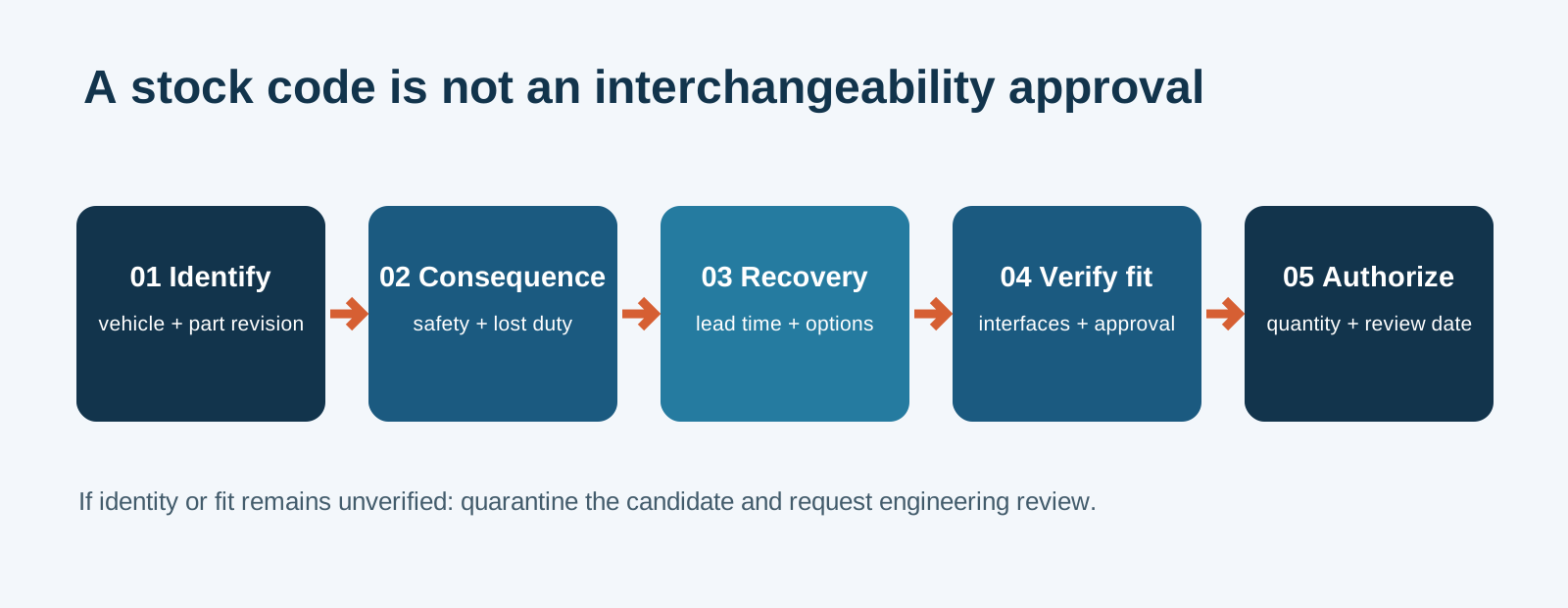
- Identify the active vehicle and installed revision.
- Rank failure consequence, approved workaround and whole recovery time.
- Verify candidate fit and approval against all affected interfaces.
- Authorize quantity, preservation and replenishment with an owner.
- Receive, fit, test and update the fleet configuration record.
What should a spares RFQ ask the supplier to prove?
Send fleet model and serial ranges, fitted component identities, drawing revisions, photos of nameplates and interfaces, actual duty, expected repair location, site access and any project-specific approval obligations. State which dimensions, settings or documents are missing. Request exact part/revision, permitted alternates, availability by location, documented lead time, preservation requirements, test report, warranty boundary and support for obsolete versions. Ask the supplier to mark deviations instead of silently quoting a visually similar item.
ShaoLi's accessories category offers a commercial starting point, not an assertion that every pictured part is in stock or compatible with every locomotive. A useful first enquiry contains the part's current identity and the vehicle's serial/model, plus the fault and operating impact. If the issue involves an electrical motor or coupling, use the dedicated replacement and coupler guides for those interfaces. Review company credentials and project documents separately; do not infer a product-specific certification from a company-level credential.
- Vehicle, assembly and part number with revision and serial/batch where available.
- Failure symptom, number of affected vehicles and approved contingency.
- Electrical, mechanical, control and environmental interface documents.
- Required shipment location, access restrictions and realistic response window.
- Requested cross-reference, deviations, preservation, test and handover records.
How should the plan remain useful after publication?
Treat the register as a live control, not an annual purchase wish list. At each major repair or configuration change, reconcile the installed bill of materials with the stock code and determine whether a previous substitute remains approved. Compare predicted and actual recovery time, unused stock, expired or degraded items and failure recurrence. Separate evidence of a changed duty from a genuine part reliability issue; otherwise the store may accumulate components that do not address the root cause.
The maintenance manager should sign the consequence ranking, engineering should own interchangeability and test criteria, and procurement should own supplier commitments and replenishment records. The mine must define its own safety and release authority. If information is missing, mark the item as provisional and specify who will obtain it. A trustworthy plan makes unknowns visible; it does not turn uncertainty into an invented probability, stock level or promised delivery time.
Frequently asked questions
What is the first spare to hold for every mining locomotive?
There is no universal first part. Rank the actual fleet's failure consequences, recovery times, approved workarounds and verified part identities.
Can one stock code cover several locomotive models?
Only if a controlled cross-reference verifies revisions and all affected mechanical, electrical, control and approval interfaces for each model.
Does frequent use alone make a part critical?
No. Consumption and criticality are separate. A rare failure may be critical when recovery is slow and no approved contingency exists.
How many units should a mine keep?
Set quantity from the mine's own fleet, duty, outage tolerance, demand evidence, supplier lead time and preservation needs; this guide provides no universal number.
Is a photograph enough to order a replacement part?
No. Obtain the vehicle and fitted-part identities, revisions, interface drawings and a documented supplier comparison.
What happens to a candidate substitute before approval?
Keep it identified as unapproved and segregated from usable stock until competent engineering and site approvals are complete.
What should be recorded after a spare is fitted?
Retain vehicle and component identities, installation and test evidence, deviations, release authority and the updated configuration record.
Sources & references
- Schalke after-sales and parts/logistics scope
Attributed OEM example of parts and support service; not proof of ShaoLi delivery time or stock.
- Brookville mining-rail vehicle families
Attributed example showing vehicle-specific assemblies and operating configurations; specifications apply only to Brookville.
- NIOSH mining electrical-injury research
US mining safety research context; follow the site's own isolation rules and jurisdiction.
Turn the guide into a project requirement
Send the route, train, duty, power, environment and interface data. ShaoLi can review the requirement against relevant product and solution paths without treating a generic guide as a final design.
Request an engineering review