Implementation Regulations for the Mineral Resources Law Enacted: Driven by the Dual Engines of Emergency Reserves and Global Expansion, New Energy Mining Equipment Reaches an Explosive Inflection Point
1. Integration into the National Strategic Reserve System: High-Standard New Energy Locomotives Become a Procurement Necessity
The Regulations further refine the systems for strategic mineral resource product reserves, production capacity reserves, and source location reserves, while optimizing emergency response measures for mineral resources. When facing contingencies or emergency mining demands, the national reserve system imposes extremely high requirements on the response speed, reliability, and baseline safety of operational equipment.
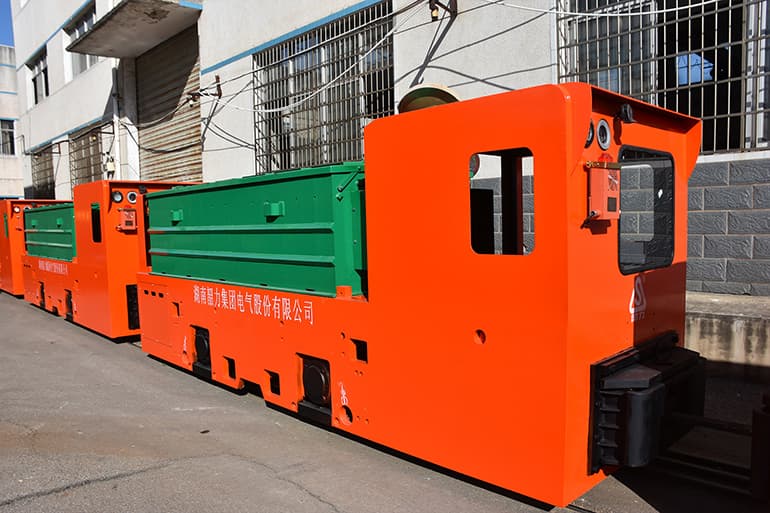
Under this policy guidance, traditional explosion-proof diesel locomotives—burdened by complex maintenance, slow startup times, and exhaust hazards—struggle to meet the strict technical criteria of national emergency reserve depots. Replacing them are fully digitalized and intelligent lithium battery mining locomotives.
Complete-vehicle manufacturers aiming to capture government procurement and emergency reserve contracts must build a strategic moat around core technical standards:
Ultimate Safety Running Gear: In underground rail transit environments, prone-to-slip and low-wear-resistance rubber tires must be completely abandoned. Standard flanged steel rail wheels must be uniformly adopted to guarantee absolute traction and heavy-duty safety under harsh emergency conditions characterized by high humidity and dense dust.
Deep Integration of the "Three-Electric" Core Systems: Reserve vehicles require long-term standby readiness and immediate operational deployment. Harnessing an advanced Battery Management System (BMS) integrated with Variable Frequency Drives (VFD) and Permanent Magnet Synchronous Motors (PMSM) not only significantly reduces the physical footprint of the powertrain but also achieves precise torque distribution and highly efficient regenerative braking, making these vehicles the benchmark for green reserve transport.
2. Policy-Backed Pathways for "Going Global": Expanding the Overseas Mining Footprint with Full-Chain Advantages
Article 7 of the Regulations explicitly states: "The state adheres to the principles of equality, mutual benefit, and win-win cooperation, actively promoting international investment, trade, and technical cooperation in the field of mineral resources through multiple channels and methods."
Spurred by these policy incentives, large Chinese mining groups will accelerate their asset allocation and mining rights investments overseas (such as in Africa, South America, and Central Asia). This wave of "going global" is no longer just a standalone export of capital, but a fully structured deployment of China's modernized mining supply chain and high-end equipment.
For mining transport equipment manufacturers, this presents unprecedented international B2B expansion opportunities, particularly within the Commonwealth of Independent States (CIS) market, including Russia and the five Central Asian nations (Kazakhstan, Uzbekistan, Kyrgyzstan, Tajikistan, and Turkmenistan):
Flawless Infrastructure Compatibility: CIS countries possess a massive inventory of legacy underground mines in urgent need of modernization. The wheelset track gauge and powertrain platforms of China's high-end lithium battery rail locomotives perfectly align with the existing narrow-gauge infrastructure in these regions. This eliminates the need for mining operators to invest in costly overhauls of overhead networks or tunnel grids, enabling low-cost, "plug-and-play" deployment.
Circumventing Technical Barriers to Trade: Leveraging a mature domestic new energy supply chain—where core components such as VFDs and PMSMs are entirely controllable and self-reliant—complete-vehicle enterprises can deliver green transport solutions boasting an optimized Total Cost of Ownership (TCO). This allows overseas clients to easily bypass carbon tariff barriers erected by Western economies.
With the official implementation of the Regulations on June 15, 2026, the underground mining equipment industry will undergo a thorough valuation reset. Only those enterprises that align themselves with the dual strategic pulses of "National Security Reserves" and "Green Equipment Globalization" will secure an invincible position in the new global mining order.