SAFETY FIRST | THE LIFELINE OF UNDERGROUND HAULAGE Braking Systems: The Ultimate Defense in Mine Locomotive Safety
Operating a mining electric locomotive boils down to five critical commands: start, stop, regulate speed, reverse, and brake.
In the grueling environment of underground haulage, towed mine cars and heavy extraction equipment lack their own independent brakes. This means the deceleration and stopping power of a massive, fully-loaded train rests entirely on the locomotive's braking system.
At Shaoli, we understand that the braking system is not just a control mechanism—it is the absolute "lifeline" safeguarding your entire fleet and the lives of your underground personnel.
Innovation-Driven: The High-Efficiency Speed Regulation System of the 5-Ton Locomotive
To optimize speed control and elevate operational safety, Chinese mining electric locomotive manufacturers are continuously pursuing technological innovation. Take the widely adopted 5-ton battery electric locomotive as an example. This series is categorized into three models: Standard, Safety-Enhanced, and Specialized Explosion-Proof, offering two speed-regulation configurations:
Stepless Speed Regulation System: Through the precise coordination of the stepless drive, controller, and governor, it achieves seamless transitions across acceleration, deceleration, and constant-speed cruising. Its core advantages lie in a highly engineered structure, exceptional explosion-proof performance, ultra-smooth startups, and outstanding energy efficiency.
Stepped Speed Regulation System: Utilizing a series-parallel combination of batteries and motors alongside a field-weakening design, this system delivers 7 distinct stages of speed regulation, ensuring zero perceptible mechanical shock during startup.
Purpose-built for confined underground spaces, this 5-ton battery electric locomotive boasts a highly compact chassis while delivering a traction force 1.5 times that of conventional DC motor locomotives of the same tonnage. Furthermore, the advanced Variable Frequency Drive (VFD) integrates comprehensive protection protocols—including under-voltage, over-voltage, over-temperature, over-current, and over-speed safeguards. Coupled with regenerative braking (charging during deceleration) and full-speed control technology, it drastically minimizes the incidence of safety accidents at the root.
Upholding the Safety Baseline: Routine Maintenance Specifications for Braking Systems
Advanced control systems rely on the steadfast support of reliable mechanical components. To maximize the locomotive's service life and guarantee absolute safety, routine braking system maintenance allows for zero compromises. Operators and maintenance crews must rigorously execute the following upkeep and calibration protocols:
Mandatory Pre-Shift Inspection: Before taking over and operating the locomotive, a comprehensive inspection of all braking components for damage or excessive wear is mandatory. Any anomalies require immediate part replacement; maintaining a zero-tolerance policy for operating defective equipment (no "working with illness").
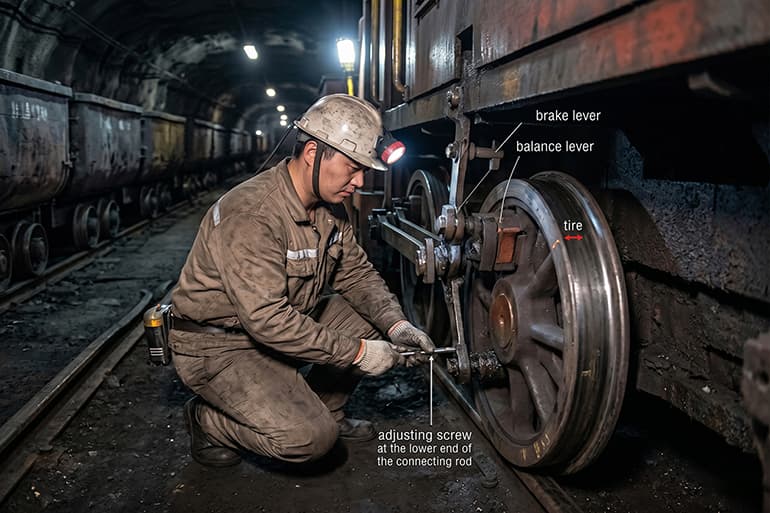
Concentricity Calibration: When the brakes are in the released position, the brake shoes and the steel wheel tire (flanged rim) must remain perfectly concentric. This prevents the braking system from tilting in the vertical plane, which would otherwise compromise braking efficacy or cause uneven wear.
Precise Clearance Adjustment: Brake shoe wear must be closely monitored. Maintenance personnel must adjust the screws at the lower end of the connecting rod to keep the clearance between the brake shoes and the steel wheel tire strictly between 2 to 3 millimeters. This tight tolerance guarantees an instantaneous braking response during emergencies.
Scheduled Lubrication: Critical active joints, such as brake screw bearings and pivot pins, must strictly adhere to a maintenance cycle of lubrication every five days. This ensures smooth, frictionless mechanical transmission without jamming.
Conclusion: Only by rigorously implementing these routine maintenance regimes and keeping the braking system in peak condition can operators truly master the broader safety landscape of underground haulage.